
cations gp I
E N D
Presentation Transcript
ilos Cations: definition, classification. Group I cations Properties of gp I cations Use different properties for separation and identification of its members
cations Ca+ion Cation Positively charged ions (lost electrons) With anion form salt Where to encounter as a pharmacist? Supplements, contrast agent, body fluids, forensic, water analysis To identify an unknown material using simple chemical tests and separations Inorganic qualitative analysis
How to separate? R. Fresenius 1841 Extremely difficult to deal with all cations simultaneously. Systematic separation of ions into smaller groups (easier). Difference in their solubility (precipitates or complex ions) 5 main Group-reagents Successive
How to separate? Extremely difficult to deal with all cations simultaneously. Systematic separation of ions into smaller groups (easier). Difference in their solubility (precipitates or complex ions) 5 main Group-reagents
How to separate? Extremely difficult to deal with all cations simultaneously. Systematic separation of ions into smaller groups (easier). Difference in their solubility (precipitates or complex ions) 5 main Group-reagents
Solution containing ions of all cation groups Group I precipitates (chlorides) + 1-2M HCl Separation Solution containing ions of remaining groups Group II precipitates (sulfides) + Thioacetamide/ dilHCl Separation Solution containing ions of remaining groups + NH4OH/ NH4Cl Group III precipitates (hydroxides) Separation Solution containing ions of remaining groups + Thioacetamide/ NH4OH/NH4Cl Group IV precipitates (sulfides) Separation Solution containing ions of remaining groups + (NH4)2CO3/NH4OH/NH4Cl Group V precipitates (carbonates) Separation Solution containing ions of Mg2+, Na+, K+, NH4+
How to separate insoluble salts ”ppt”?? Decantation Filtration Centrifugation Complete separation Supernatant Decantate ppt Material Pore size rpm Complete precipitation ppt washed free of soluble species ppt surface not adsorb contam No inclusions inside ppt ppt ppt Filtrate Time centrifuge
What if ?? Group reagent III
What if ?? • Group separation was not complete • Cations present in a small quantity will not precipitate and could be missed. • Cations left behind will pass into the next group and can interfere with the detection of the next group cations.
True or False? Classification of cations is based on varying solubility's of their chlorides, sulfides, hydroxides, and carbonate?
Group I Cations (Silver Group) Silver Ag+ MercurousHg+ Lead Pb2+ Mercurous ion Hg+Gp I Dimeric form (Hg.Hg)2+ or Hg22+ Mercury II Hg2+mercuric ion Gp II
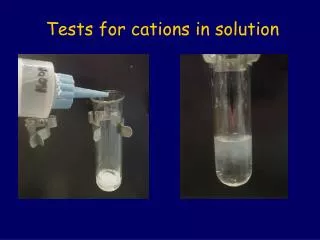
Group I Cations separation Properties: All their chlorides are insoluble in COLD water PbCl2 is soluble in hot water Ammonia dissolves silver chloride by forming Soluble silver amine chloride complex Ammonia reacts with mercurous chloride Hg2Cl2 + NH3⇌ Hg(NH2)Cl ↓ + Hg0 ↓ + NH4+ + Cl- Mercuric amidochloride(white) AgCl + 2NH3 ⇌ Ag(NH3)2Cl
Group reagent is……………… dilHCl Ag+ + Cl- → AgCl ↓ Hg22+ + 2Cl- → Hg2Cl2 ↓ Pb2+ + 2Cl- → PbCl2 ↓ white ppt NaCl can be used to precipitate group I cations (T) (F) Soluble chlorides can be used to precipitate group I cations (T) (F)
Separation of Pb2+ Confirmation of Pb2+ Pb2+ + CrO42-⇌PbCrO4↓ Canary yellow ppt • Upon cooling • reprecipitation of PbCl2
Confirmation of Ag+ Reppt upon acidification with nitric acid Yellow ppt with KI [Ag(NH3)2]+ ⇌ Ag+ + 2NH3 Ag+ + I- ⇌ AgI
Confirmation of Hg+ Disproportionation reaction Hg2Cl2⇌Hgo + HgCl2 HgCl2 + 2NH3⇌ Hg(NH2)Cl + NH4+ + Cl- Hg2Cl2+ 2NH3⇌ Hg(NH2)Cl + Hg0 + NH4+ + Cl-
Confirmation of Hg+ Dissolve in aqua regia (HgCl42-) HgCl42- ⇌ Hg2+ + 4Cl- Add stannous chloride (SnCl2) SnCl2 + 2Cl- ⇌ SnCl42- Sn2+ + 2Hg2+ ⇌ Sn4+ + Hg22+ (white ppt) Sn2+ + Hg22+ ⇌ Sn4+ + 2Hg0 (black ppt) SnCl42- + 2HgCl2 ⇌ Hg2Cl2↓+ SnCl62- SnCl42- + Hg2Cl2↓ ⇌ 2Hg↓+ SnCl62-
Interference from Cl2 Source Action How to remove? Aqua regia 2NO3- + 8H+ + 6Cl- ⇌ 3Cl2 ↑ + 2NO↑ + 4H2O Sn2+ + Cl2 ⇌ Sn4++ 2Cl- (consumes reductant)
Notes • A slight excess of HClis used to ensure better precipitation by common ion effect • Nevertheless, PbCl2is still not completely precipitated Ag+(aq) + Cl- (aq)⇌AgCl(s) HCl H+ + Cl- Common ion
Notes • Large excess of HCl will form soluble lead complex ions PbCl2 (s)⇌ Pb2+ (aq) + 2Cl- (aq) Pb2+ (aq) + 4Cl- (aq)⇌ PbCl42-(aq) 2 PbCl2 (s) + 2Cl- (aq)⇌ PbCl42- (aq) Tetrachloroplumbate (II) ion 24
If u only have ammonia and HCl Can you identify which gp I cation is present in a sample?