Download
1 / 3
30 likes | 137 Vues
Learn how aligning interests between the State and producers via SDFI brings unique advantages. Explore Norway's transition from a bonus/royalty system and strategies for implementing SDFI in Alaska. Discover a way forward by converting existing leases, focusing on challenging horizons, and establishing a professional entity to manage state interests effectively.

E N D
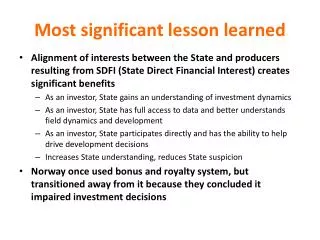
Most significant lesson learned • Alignment of interests between the State and producers resulting from SDFI (State Direct Financial Interest) creates significant benefits • As an investor, State gains an understanding of investment dynamics • As an investor, State has full access to data and better understands field dynamics and development • As an investor, State participates directly and has the ability to help drive development decisions • Increases State understanding, reduces State suspicion • Norway once used bonus and royalty system, but transitioned away from it because they concluded it impaired investment decisions
Implementing SDFI in Alaska • Can be added as an option in new leases • But, that does not reach “low hanging fruit” • Best option in the near term for offsetting production declines/increasing production is by developing viscous, heavy and economically challenged horizons in existing fields • Significant resource, no significant permitting requirements, existing infrastructure, known resource • Challenge is to make SDFI available as an option to help immediately • Important part of Norwegian model: create a professional, non-politicized corporation (similar to Permanent Fund Board) to administer state’s interest
A Way Forward • Create a mechanism for converting to SDFI under existing leases (upon mutual agreement) • Focus on new areas: previously undeveloped or underdeveloped horizons (heavy, viscous and economically challenged) • Provide option for converting to SDFI for development of those areas • Key provisions • State exchanges royalty for specified ownership percentage, fixes fiscal terms, becomes a participating owner • Parties (including State) agree to a specified work commitment for the agreed areas • Create a professional, non-politicized corporation (similar to Permanent Fund Board) to administer state’s interest