Download
1 / 7
70 likes | 175 Vues
This seminar outlines critical frameworks for biodiversity conservation, focusing on three main areas: protected area systems sustainability, biodiversity mainstreaming in production landscapes, and implementation of international protocols. Key objectives include improving agro-ecosystem services, building capacity for climate-resilient water management, and fostering cooperation across countries. Notable case studies from across the region showcase successful strategies and practices in biodiversity management and land degradation mitigation, highlighting the importance of integrated approaches to environmental challenges.

E N D
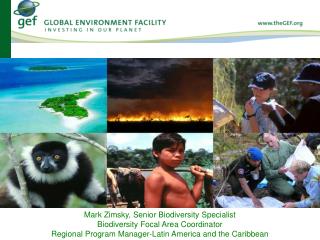
Multi-Focal Area Projects: BD, LD, and IW Mark Zimsky GEF Biodiversity Coordinator Senior Biodiversity Specialist Regional Program Manager, Latin America and the Caribbean GEF Familiarization Seminar Washington, DC January 17 – 19, 2012
Outline • Three focal areas-three results frameworks • Best practice examples
GEF-5 Biodiversity Strategy Objectives • improve the sustainability of protected area systems • mainstream biodiversity conservation and sustainable use into production landscapes/ seascapes and sectors • build capacity to implement the Cartagena Protocol on Biosafety • build capacity on access to genetic resources and benefit-sharing • integrate CBD obligations into national planning processes through enabling activities
GEF-5 IW Strategy Objectives • Catalyze multi-state cooperation to balance conflicting water uses in transboundary surface and groundwater basins while considering climatic variability and change • Catalyze multi-state cooperation to rebuild marine fisheries and reduce pollution of coasts and Large Marine Ecosystems while considering climatic variability and change • Support foundational capacity building, portfolio learning, and targeted research needs for joint, ecosystem-based management of trans-boundary water systems • Promote effective management of Marine Areas Beyond National Jurisdiction (ABNJ)
GEF-5 Land Degradation Objectives • Maintain or improve flows of agro-ecosystem services to sustain livelihoods of local communities. • Generated sustainable flows of forest ecosystem services in arid, semi-arid and sub-humid zones, including sustaining livelihoods of forest-dependent people • Reduce pressures on natural resources from competing land uses in the wider landscape • Increase capacity to apply adaptive management tools in SLM
Good practice examples • Tanzania, Marine and Coastal Environment Management Project (MACEMP), BD-IW • South West Indian Fisheries Commission Project, BD-IW • China,Mainstreaming Biodiversity Protection within the Production Landscapes and Protected Areas of the Lake Aibi Basin, BD-LD