Understanding Scale Factors in Photo Stickers and Dilations
Learn how to calculate the scale factor when creating custom photo stickers. In this example, we explore how a 4-inch by 4-inch photo can produce 1.1-inch by 1.1-inch stickers, revealing the scale factor of the reduction. We also delve into dilation concepts, demonstrating how to determine if a geometric shape is a dilation of another shape by checking if the same scale factor applies. This guide includes practical examples, visual aids, and guided practice to enhance your understanding of scale factors and their applications in transformations.


Understanding Scale Factors in Photo Stickers and Dilations
E N D
Presentation Transcript
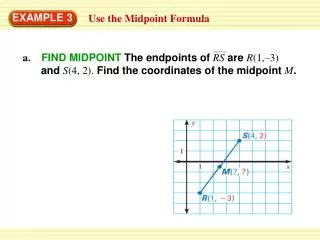
Photo Stickers You are making your own photo stickers. Your photo is 4 inches by 4 inches. The image on the stickers is 1.1 inches by 1.1 inches. What is the scale factor of the reduction? EXAMPLE 3 Find a scale factor
The scale factor is the ratio of a side length of the sticker image to a side length of the original photo, or . In simplest form, the scale factor is . 11 40 1.1 in. 4 in. EXAMPLE 3 Find a scale factor SOLUTION
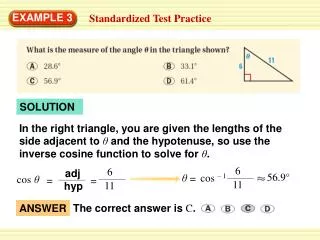
EXAMPLE 4 Standardized Test Practice SOLUTION Determine if EFGHis a dilation of PQRSby checking whether the same scale factor can be used to obtain E, F, and G from P, Q, and R.
P(3, 0) E(9, 0) Q(1, 1) F(3, 3) R(0, 2) G(0, 6) S(4, 5) H(3 4, 3 5) = H(12, 15) ANSWER (x, y) (kx, ky) The correct answer is C. CHECK:Draw rays from the origin through each point and its image. EXAMPLE 4 Standardized Test Practice k = 3 k = 3 k = 3 Because k is the same in each case, the image is a dilation with a scale factor of 3. So, you can use the scale factor to find the image H of point S.
The scale factor is the ratio of a side length of the sticker image to a side length of the original 1.1 in. photo, or . 5.5 ANSWER In simplest form, the scale factor is . 1 5 for Examples 3 and 4 GUIDED PRACTICE 3. What If? In Example 3, what is the scale factor of the reduction if your photo is 5.5 inches by 5.5 inches? SOLUTION
ANSWER A dilation with respect to the origin and scale factor k can be described as (x, y) (kx ,ky) if (x,y) = (0,0) then (kx, ky) = (k 0, k 0) = (0, 0). for Examples 3 and 4 GUIDED PRACTICE 4. Suppose a figure containing the origin is dilated. Explain why the corresponding point in the image of the figure is also the origin.