
Module 3 EO Complaint Processing Procedures
E N D
Presentation Transcript
Learning Objectives • Explain the general requirements for complaint processing procedures. • Convey the required recipient complaint processing procedures. • Distinguish between discrimination complaints and program complaints.
YOUR FACILITATORS: Kalena James – State Level EO Officer • 19 years of experience with State and Federal Government • Pursing a Masters Degree in Business Administration at IWU • Passionate about leadership and adult learning strategies Jennifer Biddle – EO Specialist • 38 years of experience in workforce development • Policy developer as well as Monitor • Deeply committed to workforce development Contact Us @ - EO@dwd.in.gov
Learning Objectives • Inform complainants of their rights and the appropriate process in filing complaints. • Define how the state guarantees compliance with Complaint Processing Procedures
General Requirements • Each state must adopt and publish procedures for processing complaints alleging discrimination against any WIOA recipient • The Governor, LWSA, and the EO Officers are responsible for developing and publishing complaint procedures • The EO Officer is responsible for ensuring that recipients follow procedures for processing discrimination complaints under 29 CFR 38.76 – 38.79. • The procedures must provide the complainant with the option to file with the recipient or directly with CRC. • All recipients must comply with the complaint procedures.
Term to Know - Recipient Any entity to which financial assistance under WIOA Title I is extended, either directly from the USDOL or through the Governor or another recipient; excluding the ultimate beneficiaries of the WIOA Title I funded programs or activities.
General Requirements • Recipients That Must Comply With Complaint Procedures • State-level agencies that administer, or are financed in whole or part with WIOA Title I funds • State Workforce Agencies • State and Local Workforce Development Boards • LWSA Grant recipients • One-Stop Operators
General Requirements • Recipients That Must Comply With Complaint Procedures • Service providers, including eligible training providers • On-the-Job Training(OJT) employers • Job Corps contractors and center operators • Job Corps national training operators • Placement agencies, including Job Corps contractors that perform these functions • Other National Program recipients
Who May File A Complaint? • Who May File a Complaint? • Any person or the person’s authorized representative who believes either of the following circumstances exist: • has been or is being subjected to discrimination prohibited under WIOA. • Has been or is being retaliated against for protected actions.
Information Required for a Complaint • Complainant’s name/address or another means of contacting the complainant • Identity of the respondent (individual or entity alleged to have discriminated) • Allegations described in sufficient detail to determine: • Jurisdiction of CRC or recipient, as applicable, over complaint • Complaint was filed within specified time • Complaint has apparent merit • A signature from the complainant or their authorized representative
Form To Be Used in Filing a Complaint • Complaint form developed by the state • Complaint Information Form (CIF) developed by the CRC • Any other document that includes the required information
Time Frame for Filing a Complaint • A complaint must be filed: • Within 180 days of the alleged discrimination • An extension of the 180-day filing period may be granted for good cause shown by the complainant • Only the Director of CRC can grant this extension
Due Process Guarantees • Agencies receiving and processing complaints are required to provide notice to all parties who have a legitimate interest in the complaint. • Regulations require that an “impartial” decision-maker investigate and process complaints.
Due Process Guarantees • Agencies are required to notify complainants of their rights to: Representation • Present evidence • Question others who present evidence • File with CRC when they are not satisfied with an agency’s decision • Decisions should be made strictly on the basis of evidence gathered.
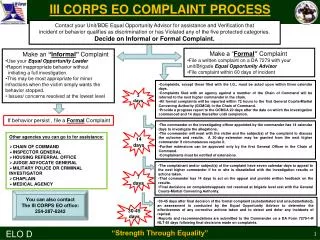
Specific Required Elements • Initial written notice • Written statement of issues • Process for fact-finding • Alternative Dispute Resolution process • Written Notice of Final Action
Specific Required Elements • Initial written notice including: • Acknowledgment of the written complaint • Notice to the complainant of his or her right to be represented in the complaint process • Notice of rights contained in EO Poster • Notice of rights to no cost auxiliary aids/services and language services • Written statement of issues including: • List of the issues raised in the complaint • Statement whether the recipient accepts the issue for investigation or rejects the issue and the reasons for each rejection
Specific Required Elements • Period for investigation or fact-finding • The choice to use customary process rests with the complainant • Period for resolution, including Alternative Dispute Resolution • Choice for the complainant to use ADR or the customary process • Provision for any party to file a complaint with the CRC Director if ADR agreement is breached
Specific Required Elements • Written Notice of Final Action including: • The recipient’s decision and explanation (investigation or fact-finding); or • A description of the resolution (e.g., ADR); and • Notice stating that if the complainant is dissatisfied with the recipient’s resolution of the complaint, he or she has the right to file a complaint with CRC within 30 days
Acceptance for Investigation or Rejection by the Recipient • Determining Jurisdiction • Respondent is a WIOA Recipient • Complaint has been filed within the 180-day time period, or the Director of CRC has granted an extension waiver • The complaint issue is covered under Section 188 of WIOA
Acceptance for Investigation or Rejection by the Recipient • Discrimination Complaints vs. Program Complaints • WIOA complaints can be divided into 2 categories: • Discrimination complaints, processed according to ETA regulations • Program complaints, processed according to ETA regulations
Acceptance for Investigation or Rejection by the Recipient • Discrimination vs. Program Complaints (cont.)
Acceptance for Investigation or Rejection by the Recipient • No Jurisdiction • Recipient must send the complainant a Written Notice of Lack of Jurisdiction including: • The reason(s) for the determination • Notice that the complainant has a right to file a complaint with CRC within 30 days of receiving the Written Notice of Lack of Jurisdiction
Processing Timeframe Requirements • Recipient’s 90-Day Processing Timeframe • Complainant’s 30-day Timeframe for Appeals • Extension of Complainant’s 30-Day Timeframe to Appeal
Processing Timeframe Requirements • Recipient’s 90-day Processing Timeframe • Issue a Written Notice of Lack of Jurisdiction • Refer the complainant to another federal grant-making agency for investigation where there is dual jurisdiction • Issue a Written Notice of Final Action
Processing Timeframe Requirements • Complainant’s 30-Day Timeframe for Appeals • Recipient issues a Written Notice of Lack of Jurisdiction • Recipient fails to issue either a Written Notice of Lack of Jurisdiction, a Written Notice of Final Action, or a referral to another federal grant-making agency within the 90-day timeframe • A party to an agreement breaches the agreement • An ADR process fails to produce an agreement
Processing Timeframe Requirements • Extension of Complainant’s 30-Day Timeframe Appeal • CRC Director may extend the complainant’s 30-day timeframe if the complainant can show good cause.
Handling Complaints Against One-Stop Partners Financially Assisted by Agencies Other than DOL • Dual Jurisdiction • Sole Jurisdiction 8-27
Handling Complaints Against One-Stop Partners Financially Assisted by Agencies Other than DOL • Dual Jurisdiction • The CRC Director or recipient refers the complaint to the grant-making agency for processing following that agency’s regulations. • Sole Jurisdiction • The CRC or recipient retains the complaint and processes it following Section 188 of WIOA, 29 CFR 38 8-28
Record-Keeping Requirements • Name and address of the complainant • Basis of the compliant • Description of the complaint • Date when the compliant was filed • Disposition of the complaint and the date the disposition was issued • Other pertinent information
Record-Keeping Requirements • Name and address of the complainant • Basis of the compliant • Description of the complaint • Date when the compliant was filed • Disposition of the complaint and the date the disposition was issued • Other pertinent information