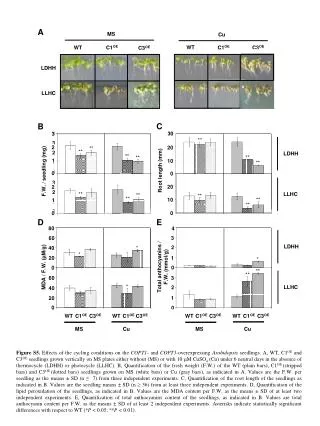
Effects of Cycling Conditions on Root Length of COPT1 and COPT3 Overexpressing Arabidopsis
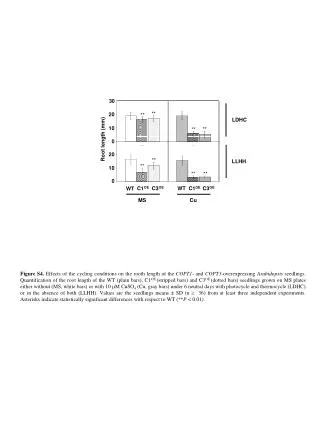
This study investigates the impact of cycling conditions on the root length of Arabidopsis seedlings overexpressing COPT1 and COPT3. We quantified root lengths of wild type (WT) and transgenic seedlings cultured on Murashige and Skoog (MS) media, both with and without 10mM CuSO4. The conditions included a photocycles and thermocycles (LDHC) versus continuous low light and high humidity (LLHH). Data represent means ± SD from three independent experiments, with significant differences marked against WT (p < 0.01).

Effects of Cycling Conditions on Root Length of COPT1 and COPT3 Overexpressing Arabidopsis
E N D
Presentation Transcript
30 20 Root length (mm) LDHC 10 0 20 LLHH 10 0 C1OE C3OE WT C1OE C3OE WT MS Cu ** ** ** ** ** ** ** ** Figure S4. Effects of the cycling conditions on the rooth length of the COPT1- and COPT3-overexpressing Arabidopsis seedlings. Quantification of the root length of the WT (plain bars), C1OE (stripped bars) and C3OE (dotted bars) seedlings grown on MS plates either without (MS, white bars) or with 10 mM CuSO4 (Cu, gray bars)under 6 neutral days with photocycle and thermocycle (LDHC) or in the absence of both (LLHH). Values are the seedlings means ± SD (n ≥ 36) from at least three independent experiments. Asterisks indicate statistically significant differences with respect to WT (**P < 0.01).
![POSITION / LENGTH /DISTANCE / DISPLACEMENT [metre m]](https://cdn1.slideserve.com/1597006/slide1-dt.jpg)