Understanding the Two Main Strategies of Immunity: Innate and Adaptive
This overview explores the two primary immune strategies: innate immunity and adaptive immunity. Innate immunity is always on standby, capable of responding rapidly to various threats, often referred to as nonspecific immunity. In contrast, adaptive immunity involves mechanisms tailored to specific pathogens, taking longer to activate but providing a strong response upon subsequent exposures, known as specific or acquired immunity. Together, these systems protect the body from infections and diseases.

Understanding the Two Main Strategies of Immunity: Innate and Adaptive
E N D
Presentation Transcript
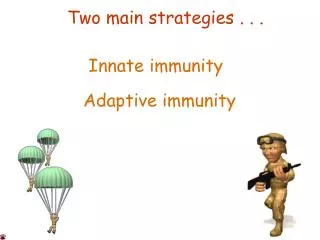
Two main strategies . . . Innate immunity Adaptive immunity
Two main strategies . . . • Innate immunity • Mechanisms always “on standby” • Can respond rapidly • Effective against a variety of different “enemies” • Also called “nonspecific immunity”
Two main strategies . . . • Adaptive immunity • Mechanisms specialized to fight a particular “enemy” • Often developed after first exposure, then “on standby” for further “attacks” • First response is slow, to allow time to prepare • Also called “specific immunity” or “acquired immunity”