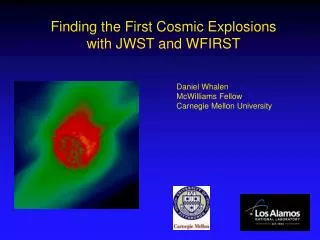
Finding the First Cosmic Explosions with JWST and WFIRST
160 likes | 279 Vues
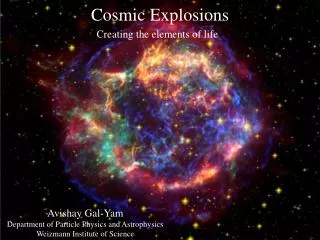
This research outlines the findings on the first cosmic explosions using the James Webb Space Telescope (JWST) and Wide-Field Infrared Survey Telescope (WFIRST). The study focuses on pair-instability supernovae and core-collapse of Population III stars, highlighting that JWST is capable of observing pair-instability supernovae (PI SNe) beyond redshift z=30, while WFIRST can detect them at z=15-20. These observations will offer vital insights into the early universe, revealing details about primordial stars, their final fates, and associated protogalaxies.


Finding the First Cosmic Explosions with JWST and WFIRST
E N D
Presentation Transcript
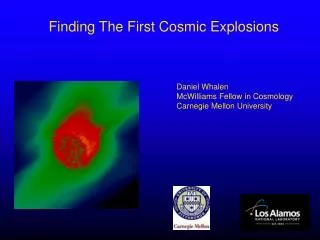
Finding the First Cosmic Explosions with JWST and WFIRST Daniel Whalen McWilliams Fellow Carnegie Mellon University
My Collaborators • Chris Fryer (LANL) • Lucy Frey (LANL) • Wes Even (LANL) • Daniel Holz (U Chicago) • Massimo Stiavelli (STSci) • Alexander Heger (U Minn) • Candace Joggerst (LANL) • Stan Woosley (UCSC)
Final Fates of the First Stars Heger & Woosley 2002, ApJ 567, 532
Pair-Instability Supernovae • non-rotating Pop III stars above 100 solar masses encounter • the pair instability after central carbon burning (Barkat et al. • 1967, Rakavy et al 1967). Rotating Pop III stars could encounter • it at only 65 solar masses (Chatzopoulos & Wheeler 2012 ApJ) • the core becomes so hot that thermal energy creates positron • electron pairs rather than providing pressure support against • gravitational collapse • the core contracts, triggering thermonuclear burning in O and Si • above 140 solar masses, the energy release completely • unbinds the star, leaving no compact remnant • at 260 solar masses the core becomes so hot that alpha particles • are photo-dissociated, triggering its collapse to a black hole
Mixing in Pop III Supernovae Joggerst, .., Whalen, et al 2010 ApJ 709, 11 Joggerst & Whalen 2011 ApJ, 728, 129
LANL Pop III Supernova Light Curve Effort Whalen et al. ApJ 2012a,b,c,d in prep • begin with 1D Pop III 15 – 40 Msol CC SN and 150 – 250 Msol • KEPLER PI SN blast profiles • evolve PI SNe out to 3 yr in the LANL radiation hydro code RAGE • evolve CC SNe out to breakout in the CASTRO AMR code, port • to RAGE, and then run out to 6 months • post-process RAGE profiles with the LANL SPECTRUM code • to compute light curves and spectra • convolve these spectra with Lyman absorption by high-redshift • neutral clouds, cosmological redshift, and filter response functions • to calculate JWST and WFIRST NIR light curves
Radiation Adaptive Grid Eulerian (RAGE) Frey, Even, Whalen et al. 2012 submitted • grey flux-limited diffusion coupled to a • high-order Godunov hydro solver on a • cell-based adaptive mesh refinement grid • matter and radiation temperatures, while • coupled, are evolved separately • energy due to radioactive decay of 56Ni is • locally deposited in the gas • LANL OPLIB database of atomic opacities
Light Curves u-series (red hypergiants) z-series (blue compact giants)
JWST NIRCam Light Curves at z = 30 • NIRCam detection threshold • is absolute magnitude 32 for • deep surveys • PI SNe will be visible to JWST • beyond z = 30 and will even be • able to perform spectrometry • on them • Although JWST’s deep field will • be very narrow, it is expected • that at least a few PI SNe will • be in them in a given survey • (Hummel et al. 2011, ApJ)
z = 15 z = 20 • all sky NIR survey • mission • proposed sensitivity • of AB magnitude • 26.5 @ 2.2 μm WFIRST could detect large numbers of Pop III PI SNe at z = 15 – 20, which may be their optimum redshift for detection due to Lyman-Werner UV backgrounds
Preliminary Pop III Core-Collapse SN Light Curves z25B z25B z25D z25G
JWST NIRCam Light Curves for 15 – 40 Solar Mass Core-Collapse Supernovae
Conclusions • JWST will see Pop III PI SNe beyond z = 30, and • WFIRST will find them at z = 15 - 20 • Pop III CC SNe will be visible in the NIR only • out to z ~ 7 – 10 • Pop III Type IIne and hypernovae may be visible • to z ~ 10 - 15 • they will be our first direct probe of the Pop III IMF • they will also reveal many protogalaxies that would • otherwise not be detected by next generation • observatories