SlideServe
Menu
Préférences
© SlideServe · v2026

Lessons Learned from Assessing Eco-Efficiency in Electric Mobility

amiel avatar
16 diapositives · 288 Views · Sep 15, 2014

This paper discusses insights from the assessment of eco-efficiency in electric mobility, presented at the STOA Lunch Debate in Brussels on May 7, 2013. Key topics include the evolution, environmental impacts, and future outlook of electric vehicles (EVs) and other technologies like hydrogen and hybrid cars. It explores the balance between electric mobility being part of the solution versus becoming a problem. The study emphasizes the importance of efficiency, lifecycle greenhouse gas emissions, battery developments, and recycling strategies to promote sustainable mobility.
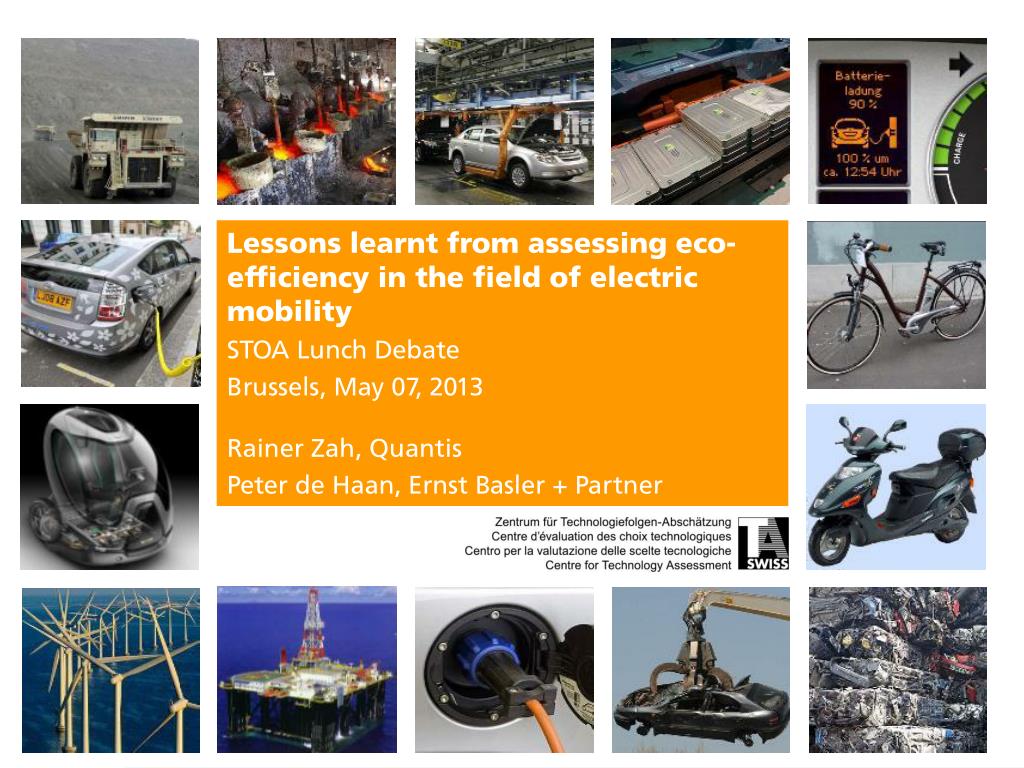
Lessons Learned from Assessing Eco-Efficiency in Electric Mobility - slide 1
01 / 16Lessons Learned from Assessing Eco-Efficiency in Electric Mobility
1 / 17

Télécharger la présentation

Lessons Learned from Assessing Eco-Efficiency in Electric Mobility
Une image / un lien ci-dessous est fourni (tel quel) pour télécharger la présentation

Politique de téléchargement : le contenu du site vous est fourni TEL QUEL pour votre information et votre usage personnel ; il ne peut être vendu, concédé sous licence ni partagé sur d’autres sites sans l’accord de son auteur.Le contenu vous est fourni TEL QUEL, pour votre information et votre usage personnel uniquement. Téléchargez la présentation en cliquant sur ce lien. Lors du téléchargement, si vous ne parvenez pas à télécharger une présentation, l’éditeur a peut-être supprimé le fichier de son serveur.Pendant le téléchargement, si vous ne parvenez pas à obtenir une présentation, le fichier a peut-être été supprimé par l’éditeur.

F I N

Plus de contenu associé

Transcription de la présentation
  1. Lessons learnt from assessing eco-efficiency in the field of electric mobility STOA Lunch Debate Brussels, May 07, 2013Rainer Zah, Quantis Peter de Haan, Ernst Basler+ Partner

  2. From Hype to Analysis Againandagain: hopingfornewmobilitytechnologiesthataresustainablewithoutneedforchangingbehavior: • Electriccarsofthe 90ies • Natural gas cars • Hybrid cars • Hydrogen cars • Electriccarsoftoday … but emobilityis not THE solution… Whenisemobilitypartofthesolution („opportunity“),whenisitpartoftheproblem („risk“)?

  3. Scopeofthestudy • Future development of cars, power supply and user behavior for the years 2012, 2020, 2035 und 2050. • eMobility = electric engine + >50% power from grid: H2-cars and hybrids are excluded Combustionengine

  4. Methods Future developmentofcarcomponents (Literaturestudy) Future developmentof power supply (Gov. Scenarios) Environmental impactassessment Env. Impacts offutureelectriccars (LCA) Emobilitypenetrationmodel (ABM) Env. Impacts of Swiss fleet

  5. Batteriesaskeyfactorforemobilitypenetration range? 500km energydensity on batterylevel (Wh/kg) 150km

  6. Potential developmentofbatterycosts Costs on batterylevel ($/kWh)

  7. Methods Future developmentofcarcomponents Future developmentof power supply Environmental impactassessment Env. Impacts offutureelectriccars Emobilitypenetrationmodel Env. Impacts of Swiss fleet

  8. Development of Life Cycle GHG Emissions 80% <10% ICE BEV greenhouse gas emissionscompact-cars (kg CO2-eq/km)

  9. The roleoftheelectricity mix BEV; certifiedeco-power, CH, real BEV; governmentalscenario, CH, real BEV; consumer mix, CH, real BEV; natural gas power plant , EU, real BEV; consumer mix, EU, real BEV; coal power plant , EU, real ICE; EU-goal 2025, 70g/km CH, NEDC ICE; EU-goal 2025, 70g/km CH, real ICE; Canadianoilsands CH, real Greenhouse gas emissions (g CO2-eq./km)

  10. Methods Future developmentofcarcomponents Future developmentof power supply Environmental impactassessment Env. Impacts offutureelectriccars Emobilitypenetrationmodel Env. Impacts of Swiss fleet

  11. Manyforecastsarehigherthenthetechnicalproductioncapacityofelectriccars!Manyforecastsarehigherthenthetechnicalproductioncapacityofelectriccars! Maximum global productioncapacity

  12. Electricmobility will neverreach 100%;Co-existencewith ICE carseven after 2050 Percentagesales

  13. Methods Future developmentofcarcomponents Future developmentof power supply Environmental impactassessment Env. Impacts offutureelectriccars Emobilitypenetrationmodel Env. Impacts of Swiss fleet

  14. Howare GHG emissionsdeveloping? Greenhouse gas emissionsofthe Swiss individual carfleet relative to 2012

  15. Lessonslearnt… • Focus on efficiencyfor all cars: positive impacts on all aspects. Indirectsupportofelectricmobility. Reducesriskforwrongincentives • Frommineraloiltaxtoroadtax: start smooth transitionsoon. This supports also mixedmobilityforlongdistancedriving. • Focus on recycling: improvecomponentreuseandrecyclingoflithiumand rare metalsfromelectericcars. • Rebound effects:equaltaxes per km. Continuewithtaxesforpossessing a car (even a smallcar).

  16. freeaccess: www.ta-swiss.ch