Optimizations for Locality-Aware Structured Peer-to-Peer Overlays
120 likes | 253 Vues
This paper discusses various optimizations aimed at improving locality in structured peer-to-peer (P2P) overlays. The focus is on enhancing latency, efficiency, and availability through strategic storage and retrieval techniques. Key optimizations include implementing redundancy for backups, utilizing nearest neighbors for publishing, and the use of local surrogates to minimize wide-area hops. Experiments conducted in simulations demonstrate the effectiveness of these strategies, providing insights for future work and potential applications in decentralized systems.


Optimizations for Locality-Aware Structured Peer-to-Peer Overlays
E N D
Presentation Transcript
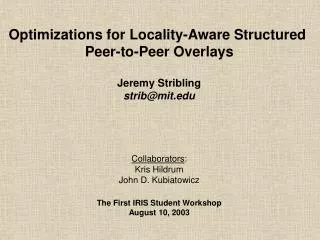
Optimizations for Locality-Aware Structured Peer-to-Peer Overlays Jeremy Stribling strib@mit.edu Collaborators: Kris Hildrum John D. Kubiatowicz The First IRIS Student Workshop August 10, 2003
Berkeley Rice Object Location in Tapestry MIT IRIS Student Workshop – 8/10/03
Berkeley Rice Is This Always Optimal? MIT IRIS Student Workshop – 8/10/03
Discussion • Why is this a problem? • Latency, efficiency, availability • Metric: Relative Delay Penalty (RDP) • Distance through Tapestry vs. IP distance • Solution: trade storage for low local area RDP • Will work in DOLRs with a pointer indirection layer IRIS Student Workshop – 8/10/03
Rice Optimization 1: Backups • Redundancy: Store up to c nodes in each entry • c–1 nodes are backups • A simple optimization: publish to b backups • Limit to first h hops of publish path • Result • Nodes near the object more likely to encounter pointers • Cost: b*h additional pointers per object IRIS Student Workshop – 8/10/03
Optimization 1: Backups Experiments run in simulation on a GT-ITM transit stub topology IRIS Student Workshop – 8/10/03
Rice Optimization 2: Nearest Neighbors • Observation: In Opt. 1, choice for backups is limited • But lots of nodes at each level, many may be nearby • Optimization: publish to n nearest neighbors • Limit to first h hops of the publish path • Result • If n is large, essentially local area flooding • Analytical cost: n*h additional pointers per object IRIS Student Workshop – 8/10/03
Optimization 2: Nearest Neighbors Experiments run in simulation on a GT-ITM transit-stub topology IRIS Student Workshop – 8/10/03
Rice Optimization 3: Local Surrogate MIT Berkeley IRIS Student Workshop – 8/10/03
<= x*t ms > x*t ms x ms Optimization 3: Local Surrogate • Solution: Check local node before leaving • When publishing, place a pointer on local surrogate • Occurs naturally on Coral, LAND, SkipNet • In practice, storage cost is very low • Issue: What determines a wide area hop? • One metric: if next hop is more than t times longer than last hop, consider it wide area IRIS Student Workshop – 8/10/03
Optimization 3: Local Surrogate Experiments run in simulation on a GT-ITM transit-stub topology IRIS Student Workshop – 8/10/03
Future Work • Automatically adjust t when using local surrogate • Take measurements on actual networks • Test optimizations with real workloads • Evaluate the maintenance cost Questions? IRIS Student Workshop – 8/10/03