Mastering Scientific Notation: Multiplication, Division, Addition, and Subtraction
This guide covers the essential rules for calculating with scientific notation, including steps for multiplication, division, addition, and subtraction. Learn how to multiply coefficients and add exponents, divide coefficients while subtracting exponents, and align decimals for accurate addition or subtraction of numbers in scientific notation. With practical examples like (5.44 × 10^7 g) ÷ (8.1 × 10^4 mol), you'll gain confidence in using scientific notation for various calculations, ensuring your answers are expressed in standard form.

Mastering Scientific Notation: Multiplication, Division, Addition, and Subtraction
E N D
Presentation Transcript
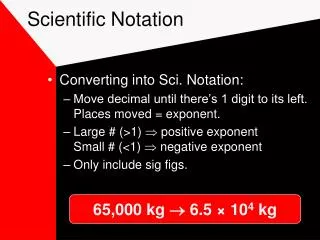
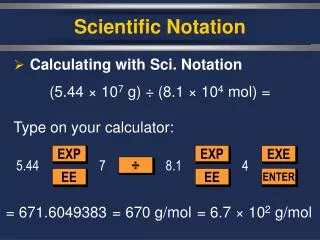
EXE EXP EXP ENTER EE EE Scientific Notation • Calculating with Sci. Notation (5.44 × 10⁷ g) ÷ (8.1 × 10⁴ mol) = Type on your calculator: 5.44 7 8.1 4 ÷ = 671.6049383 = 670 g/mol = 6.7 × 10² g/mol
Scientific Notation • Multiplication Multiply the coefficients, and add the exponents (3 x 104) x (2 x 102) = (2.1 x 103) x (4.0 x 10-7) = 6 x 10⁶ 8.4 x 10⁻⁴
Scientific Notation • Division Divide the coefficients, and subtract the denominator exponent from the numerator exponent 3.0 x 10⁵ 6.0 x 10² Note that the answer has been expressed in standard form = 0.50 x 103 = 5.0 x 10²
Scientific Notation • Addition and Subtraction • Before numbers can be added or subtracted, the exponents must be the same; line up decimal • Changing the smaller exponent to the larger one will usually give a coefficient between 1 and 10
Scientific Notation • Addition and Subtraction • (6.6 x 10⁻⁸) + (4.0 x 10⁻⁹) = • (3.42 x 10⁻⁵) – (2.5 x 10⁻⁶) = 7.0 x 10⁻⁸ 3.17 x 10⁻⁵ Note that these answers have been expressed in standard form