Download
1 / 12
120 likes | 241 Vues
This report evaluates the surface currents derived from the ROAM project using IMOS data from an HF radar system off the coast of Perth, which provides real-time maps of current velocity near the surface up to ~100 km. The study compares these measurements against ADCP data from Townsville to assess the accuracy and reliability of the RF data. The findings show a fair agreement in the V component of the inertial oscillations, especially during different runs, highlighting the need for data assimilation for better precision in larger domains.

E N D
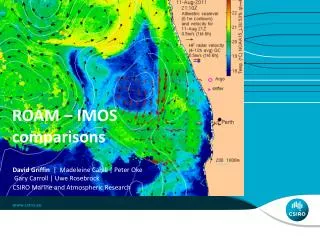
ROAM – IMOS comparisons David Griffin | Madeleine Cahill | Peter Oke Gary Carroll | Uwe Rosebrock CSIRO Marine and Atmospheric Research
Evaluation of ROAM surface currentsusing IMOS data HF radar system off Perth – only instrument to provide maps of current velocity right near the surface, out to ~100km depending on radar range at the time Look at this first, then briefly also: ADCPs off Townsville (more regular in time, all depths below ~12% of water depth, isolated locations). David Griffin
Lets look at time series of u and v at these 5 points David Griffin
Agreement (V component) fairly good, especially phase of inertial oscillations David Griffin
Eastward velocity component (u) also OK David Griffin
Different run (slightly bigger domain): more disagreement David Griffin
Especially for V (northward velocity) David Griffin
Larger domain: needs data assimilation (not used for this run, will do soon) David Griffin
Off Townsville, daily averages at 20m, fair qualitative agreement David Griffin
Tides also good. Roll eddy imaginary? David Griffin
Thankyou. Sorry I couldn’t make it. David Griffin