Download
1 / 8
80 likes | 211 Vues
ORDER OF OPERATIONS. How to do a math problem with more than one operation in the correct order. . PEMDAS. Remember the order by the phrase Please Excuse My Dear Aunt Sally. The “P” and “E”. The “P” stands for items in parenthesis Do all items in the parenthesis first.

E N D
ORDER OF OPERATIONS How to do a math problem with more than one operation in the correct order.
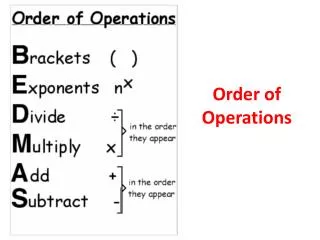
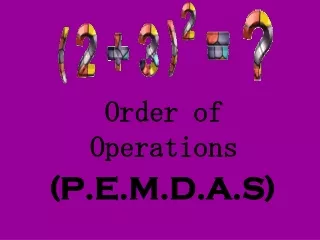
PEMDAS • Remember the order by the phrase • Please • Excuse • My Dear • Aunt Sally
The “P” and “E” • The “P” stands for items in parenthesis • Do all items in the parenthesis first (2 + 3) The “E” stands for Exponents Do anything that has a exponent (power) 82
The “MD” • Represents Multiply and Divide • Do which ever one of these comes first in the problem Work these two operations from left to right
The “AS” • Represents Add and Subtract • Do which ever one of these comes first • Work left to right 8 + 7 - 5 + 2
1) 5 + (12 – 3) 5 + 9 14 2) 8 – 3 • 2 + 7 8 - 6 + 7 2 + 7 9 3) 39 ÷ (9 + 4) 39 ÷ 13 3
15 • 103 15 • 1,000 15,000 • 10 + 8 ÷ 2 – 6 10 + 4 - 6 14 - 6 8 36 ÷ (1 + 2)2 36 ÷ 32 36 ÷ 9 4 7) 3 • 104 3 • 10,000 30,000
14 + 3(7 -2) – 2 • 5 14 + 3 • 5 - 2 • 5 14 + 15 - 2 • 5 14 + 15 – 10 29 – 10 19 • (5 – 1)3 ÷ 4 43 ÷ 4 64 ÷ 4 16