Download
1 / 3
0 likes | 1 Vues
Gain your HACCP certification for food safety compliance. Enroll in accredited courses to advance your career in food industry quality assurance today.

E N D
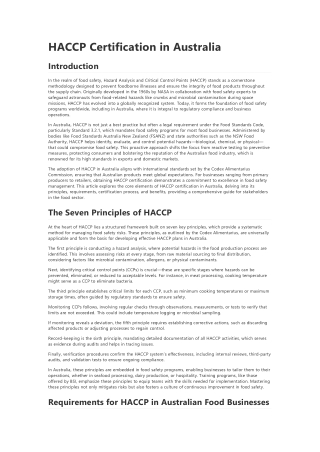
HACCP Certification in Australia Introduction In the realm of food safety, Hazard Analysis and Critical Control Points (HACCP) stands as a cornerstone methodology designed to prevent foodborne illnesses and ensure the integrity of food products throughout the supply chain. Originally developed in the 1960s by NASA in collaboration with food safety experts to safeguard astronauts from food-related hazards like crumbs and microbial contamination during space missions, HACCP has evolved into a globally recognized system. Today, it forms the foundation of food safety programs worldwide, including in Australia, where it is integral to regulatory compliance and business operations. In Australia, HACCP is not just a best practice but often a legal requirement under the Food Standards Code, particularly Standard 3.2.1, which mandates food safety programs for most food businesses. Administered by bodies like Food Standards Australia New Zealand (FSANZ) and state authorities such as the NSW Food Authority, HACCP helps identify, evaluate, and control potential hazards—biological, chemical, or physical— that could compromise food safety. This proactive approach shifts the focus from reactive testing to preventive measures, protecting consumers and bolstering the reputation of the Australian food industry, which is renowned for its high standards in exports and domestic markets. The adoption of HACCP in Australia aligns with international standards set by the Codex Alimentarius Commission, ensuring that Australian products meet global expectations. For businesses ranging from primary producers to retailers, obtaining HACCP certification demonstrates a commitment to excellence in food safety management. This article explores the core elements of HACCP certification in Australia, delving into its principles, requirements, certification process, and benefits, providing a comprehensive guide for stakeholders in the food sector. The Seven Principles of HACCP At the heart of HACCP lies a structured framework built on seven key principles, which provide a systematic method for managing food safety risks. These principles, as outlined by the Codex Alimentarius, are universally applicable and form the basis for developing effective HACCP plans in Australia. The first principle is conducting a hazard analysis, where potential hazards in the food production process are identified. This involves assessing risks at every stage, from raw material sourcing to final distribution, considering factors like microbial contamination, allergens, or physical contaminants. Next, identifying critical control points (CCPs) is crucial—these are specific stages where hazards can be prevented, eliminated, or reduced to acceptable levels. For instance, in meat processing, cooking temperature might serve as a CCP to eliminate bacteria. The third principle establishes critical limits for each CCP, such as minimum cooking temperatures or maximum storage times, often guided by regulatory standards to ensure safety. Monitoring CCPs follows, involving regular checks through observations, measurements, or tests to verify that limits are not exceeded. This could include temperature logging or microbial sampling. If monitoring reveals a deviation, the fifth principle requires establishing corrective actions, such as discarding affected products or adjusting processes to regain control. Record-keeping is the sixth principle, mandating detailed documentation of all HACCP activities, which serves as evidence during audits and helps in tracing issues. Finally, verification procedures confirm the HACCP system’s effectiveness, including internal reviews, third-party audits, and validation tests to ensure ongoing compliance. In Australia, these principles are embedded in food safety programs, enabling businesses to tailor them to their operations, whether in seafood processing, dairy production, or hospitality. Training programs, like those offered by BSI, emphasize these principles to equip teams with the skills needed for implementation. Mastering these principles not only mitigates risks but also fosters a culture of continuous improvement in food safety. Requirements for HACCP in Australian Food Businesses
HACCP requirements in Australia are governed by a robust regulatory framework that ensures uniformity across states and territories. Under the Australia New Zealand Food Standards Code, particularly Standard 3.2.1, most food businesses must implement a HACCP-based food safety program (FSP). This is especially mandatory for high-risk operations like those handling raw meats, seafood, or ready-to-eat foods, where the potential for hazards is elevated. Businesses are required to develop a documented FSP that incorporates the seven HACCP principles, including hazard analysis and control measures. Prerequisite programs, such as good hygiene practices, pest control, and staff training, must also be in place to support the HACCP plan. For example, in New South Wales, the NSW Food Authority provides industry-specific templates for FSPs, which businesses must customize to address their unique hazards and comply with local regulations. Auditing is a key requirement; FSPs must be reviewed annually and audited by qualified food safety auditors. Records of monitoring, corrective actions, and verifications must be maintained and made available during inspections by Environmental Health Officers (EHOs). Failure to comply can result in penalties, including fines or operational shutdowns. Additionally, for certification, businesses often align with global standards like those from the Global Food Safety Initiative (GFSI), which recognize HACCP as a prerequisite. Training is essential—courses covering the five preliminary steps (like assembling a HACCP team and describing the product) and the seven principles are widely available, leading to qualifications such as FBPAUD4004. These requirements extend across the supply chain, from farms to exporters, ensuring Australia’s food exports meet international demands and maintain the country’s reputation for safety. The Process of Obtaining HACCP Certification Obtaining HACCP certification in Australia involves a methodical process that begins with commitment from management and extends to third-party verification. Initially, businesses conduct a gap analysis to assess current practices against HACCP requirements, often with the help of consultants who provide expert guidance. The next step is assembling a multidisciplinary HACCP team and following the five preliminary steps: describing the product, identifying intended use, constructing a flow diagram, verifying the diagram on-site, and listing all hazards. This leads into applying the seven principles to develop a comprehensive HACCP plan. Implementation follows, where controls are put in place, staff are trained, and monitoring systems are established. Mock audits can help identify weaknesses before formal assessment. Certification is typically sought from accredited bodies like SAI Assurance or IAS Australia, which conduct stage-one (documentation review) and stage-two (on-site audit) assessments. Upon successful audit, certification is granted, usually valid for one to three years, with surveillance audits in between. Common pitfalls include inadequate documentation or staff training, which can be mitigated by engaging consultants for tailored support, including plan development and refresher courses. The process, while rigorous, is supported by resources from authorities like the NSW Food Authority, ensuring businesses can achieve certification efficiently. Benefits of HACCP Certification for Businesses HACCP certification offers multifaceted benefits that extend beyond compliance, enhancing operational efficiency and market positioning for Australian food businesses. Primarily, it provides stronger control over food safety hazards, reducing the risk of recalls and associated financial losses. Market access is significantly improved; certification is often a prerequisite for supplying major retailers, quick- service restaurants, and exporting to international markets, where standards like those from Codex are expected. This opens doors to premium buyers and boosts export potential, crucial for Australia’s agribusiness sector. Internally, it drives process improvements, such as streamlined production and reduced waste, leading to cost savings. Enhanced documentation and staff engagement foster a culture of continuous improvement, increasing operational resilience. Reputationally, certification builds consumer trust and confidence from regulators, minimizing the impact of potential outbreaks. It also provides a competitive edge, differentiating certified businesses in a crowded market. Overall, the investment in HACCP yields long-term returns through safer products, regulatory adherence, and business growth.
Conclusion HACCP certification Australia represents a vital commitment to food safety, underpinned by a proven methodology that safeguards public health and supports economic vitality in the food industry. From its foundational seven principles to the rigorous requirements and certification process, HACCP equips businesses with the tools to proactively manage risks and achieve excellence. The benefits—ranging from enhanced market access to operational efficiencies—underscore why HACCP is indispensable in today’s globalized food landscape. As regulations evolve and consumer expectations rise, maintaining HACCP certification will remain essential for Australian businesses to thrive, ensuring safe, high- quality food for all. By embracing this system, the industry not only complies with standards but also contributes to a safer future.









![PMP Certification in Dubai [Mindcypress ] Project Management Professional and PMP Certification Training](https://cdn4.slideserve.com/8465876/slide1-dt.jpg)