2.2 Definitions and Biconditional Statements
This lesson focuses on the essential concepts of definitions and biconditional statements within geometry. Students will learn to recognize and utilize definitions, such as perpendicular lines, as well as biconditional statements, which connect hypotheses and conclusions through the phrase "if and only if." The lesson includes working with examples involving collinearity, perpendicular lines, and the Angle Addition Postulate. The aim is to strengthen understanding of geometric principles and enhance logical reasoning skills.

2.2 Definitions and Biconditional Statements
E N D
Presentation Transcript
Goals • Recognize and use definitions • Recognize and use biconditional statements Geometry
Perpendicular Lines • 2 lines that intersect to form a right angle • Line Perpendicular to a Plane • A line that intersects a plane in a point and is perpendicular to every line in the plane that it intersects • The symbol is read as “is perpendicular to” n m m ┴ n Geometry
Example 1: Using Definitions • Decide whether each statement about the diagram is true. Explain your answer. • Points D, X, and B are collinear. • Line AC is ┴ to line DB • Angle AXB is adjacent to angle CXD True True A False X D B C Geometry
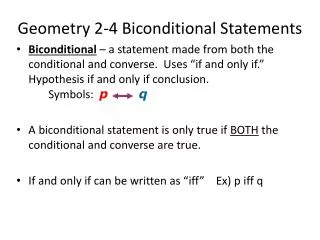
Using Biconditional Statements • Conditional statements can also be written only-if form • It is Saturday, only if I am working at the store • Hypothesis- it is Saturday • Conclusion- I am working at the store • Biconditional Statement • Is a statement that contains the phrase “if and only if” • This is equivalent to writing a conditional statement and its converse Geometry
Example 2: Writing a Postulate as a Biconditional • The converse of the Angle Addition Postulate is true. Write the converse and combine it with the postulate to form a true biconditional statement. • Converse • If m<RSP + m<PST = m<RST, then P is on the interior of <RST. • Biconditional • P is in the interior of <RST if and only if m<RSP + m<PST = m<RST Geometry