Download
1 / 55
560 likes | 715 Vues
This section explores various nuclear imaging techniques, including Gamma Cameras invented by H. Anger in the 1960s, which are fundamental to nuclear imaging. We delve into Positron Emission Tomography (PET) and its principles, including annihilation coincidence detection and technology involved. The integration of PET with CT scans is also discussed, facilitating precise localization within the body. Additionally, we cover advancements in Computer Tomography (CT), including multiple detector rings for faster and more efficient imaging, addressing their role in modern medical diagnostics and non-invasive surgical techniques.

E N D
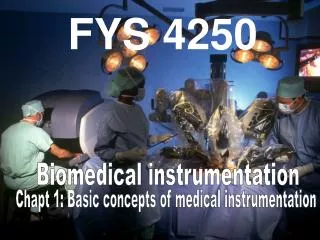
FYS 4250 Biomedical instrumentation Chapt 12b: Nuclear imaging methods
Overview • Gamma camera • Positron emission technology (PET) • Computer tomography (CT) • Proton therapy • Electrical impedance tomography (EIT)
Gamma Camera • A camera for nuclear imaging. The most used so far was invented by H. Anger in the 1960’s (The Anger camera)
Anger camera Photons with a proper direction are let through the collimator, into the detector and photomultipliers
Actualisotopes(2) half life half life ”parents”
Annihilation coincidence detection • Emitted positrons lose their kinetic energy by causing excitation and ionization • A positron that has lost most of the energy will interact with an electron by an annihilation • This annihilation will convert the mass of the electron-positron pair into two 511-keV photons, emitted in contrary directions
Annihilation coincidence detection • If a simultaneous photon is registered in two different detectors, the annihilation came into being along a straight line between the two detectors . The electronics within a scanner detects the simultaneous hits in a process called annihilation coincidence detection • When two simultaneous hits have been detected, a line between the two detectors is calculated
True, random, and scatter coincidences • A true coincidence = detection is the result of a single nuclear annihilation • A random coincidence = photons from different nuclear transformations are detected simultaneously at the detectors. May give erroneous results. • A scatter coincidence = one or both photons from a single annihilation are scattered in different directions but still detected in the detector
Design of a PET scanner • PET = scintillation crystals coupled to photomulitiplier tubes (PMT) • The signals are then processed in pulse mode in order to find the position, energy and the timestamp for each interaction • The energy levels can be used to discriminate between scatter coincidences and true coincidences • Early PET scanners coupled each scintillation crystal to a single PMT • Size of individual crystal largely determined spatial resolution of the system • Modern designs couple larger crystals to more than one PMT • Relative magnitudes of the signals from the PMTs coupled to a single crystal used to determine the position of the interaction in the crystal
PET-CT • Usually combined with CT in order to localize activity in the body
Non-invasive surgery Kilde: NIRS, Chiba, Japan
Non-invasive surgery Heavy ion therapy (Proton-terapi) http://www.nature.com/nature/journal/v449/n7159/box/449133a_BX1.html Kilde: NIRS, Chiba, Japan http://www.triumf.info/public/about/virtual_tour.php?section=3&single=18
Non-invasive surgery A treatment for patients with a local tumor not possible to treat with regular therapeutic methods Kilde: Magne Guttormsen, Fysisk Institutt, UIO
Non-invasive surgery Better dose distribution to the tumor Source: Magne Guttormsen, Fysisk Institutt, UIO
Non-invasive surgery Kilde: NIRS, Chiba, Japan
Non-invasive surgery Minimalized heavy ion therapy centre Tung-kjerne terapi sentre • Less size than today’s centres • Reduced investmentcost, approximately 800 mill NOK Kilde: NIRS, Chiba, Japan
What is the CT? • Mathematical transform to the measured data. • Reconstruct n dimension function (image) => projection data of n – 1 dimension • Radon Transform (1917)“Two dimension and three dimension object can be reconstructed from the infinite set of projection data”. • The First CT: 1973 in the U.S.4 minutes scan, thickness of 10mm
Concept of CT ・Getting the shape by back projection of the projection data. ・For example, outward view is the quadrangle => it is the cylinder CT Algorithm
X Blur Basic principle of CT-Reconstruction of 2 dimensional image- Projection Data curvilinear integral of absorption coefficient regarding Y y y X-ray detector array Y X x x object X X-ray tube Reconstruction field Data Acquisition field Simple Backprojection
1., 2. and 3. generation scannerLinear translation + rotationCirkular scanningVolume scanning
CT picture new technology Source:http://tidsskriftet.no/article/877021
Geometry of a CT-scanner
Back- projection (1)
Back- • projection (2)
y X x x ω or x Basic principle of CT -Reconstruction of 2 dimensional image- Projection Data x * Filtered Projection data Reconstruction Filter Multidirectional Backprojection Filtered Backprojection
CT image
Multislice CT • Several rings of detectors for multiple scanning of several layers. • Time efficiant, a 4 slice multislice CT is up to 8 times faster than a single slice CT • Possible monitoring of a beating heart ++
Reconstruction process Data acquisition at angle : 0 – 180 degree Obtain F(u,v) and then 2D IFFT -> reconstruction Radon Transform is equivalent to Filtered backprojection !
Example of Simulation Model Image SimpleBackprojection Filtered Backprojection