Understanding Social Behavior in Animal Groups: Advantages, Disadvantages, and Interactions
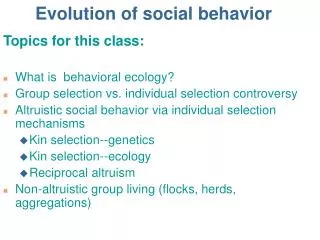
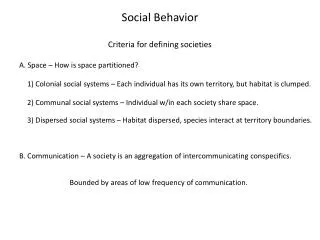
Animals of the same species often form stable groups characterized by cooperative relationships. This social behavior offers numerous advantages, such as protection from predators, increased feeding efficiency, and better access to mates. However, grouping can also lead to competition for resources, increased disease transmission, and parasite infestations. Aggression within these groups helps maintain territory and dominance hierarchies. Altruism is another fascinating aspect, where individuals may sacrifice their reproductive potential for the benefit of the group, as seen in species like honeybees and naked mole rats.

Understanding Social Behavior in Animal Groups: Advantages, Disadvantages, and Interactions
E N D
Presentation Transcript
Social Behavior • Members of the same species • Usually live full-time in groups • Can refer to predator-prey interactions
Group Living • Animal society – stable group of individuals of the same species that have cooperative relationships outside of mating and raising young. • Invertebrates and vertebrates
Advantages to Group Life • Protection from predators • Increase feeding efficiency • Protection from elements • Easy access to potential mates
Disadvantages of Group Life • Competition for resources • Diseases • Parasites
Aggression • Agonistic behavior • Attacks • Threat displays • Maintains territory • Maintains dominance hierarchy
Altruism • Individual sacrifices reproductive potential for the benefit of others in the group • Honeybees • Turkeys • Naked mole rats • Kin selection