Download
1 / 11
110 likes | 253 Vues
This overview explores energy changes during chemical reactions, highlighting how bonds break and form. Every reaction involves energy absorption or release, classified into endothermic and exothermic processes. Endothermic reactions absorb heat, leading to a temperature decrease and a positive change in enthalpy (∆H), while exothermic reactions release heat, causing a temperature increase and a negative ∆H. Activation energy, necessary to initiate reactions, is also discussed. Understanding these concepts is crucial for predicting reaction behavior and energy dynamics.

E N D
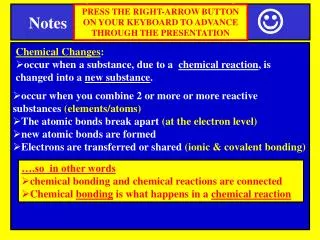
Chemical change-new substance is formed starting substances new substances or reactants products
Virtually every chemical reaction is accompanied by absorption or release of energy. • Energy is absorbed to break bonds of reactants and energy is released when bonds form.
Heat of Reaction- amount of heat released or absorbed during a reaction (Enthalpy) • ∆H: change in enthalpy (amount of energy absorbed or lost as heat during a reaction) • ∆H = Hproducts – Hreactants • Energy measured in kJ (kilojoules)
Endothermic Reactions • Energy is absorbed during a reaction Reactants Products low energy high energy reactants + energy products ∆H = heatproducts - heatreactants
Endothermic ∆H = Hproducts - H reactants • Heat absorbed • ∆H is positive • Temperature decrease • Reactants have less chemical potential energy than products, difference is absorbed ∆H Energy activation energy Reactants Products
Exothermic Reactions • Energy is released during a reaction Reactants Products high energy low energy Reactants products + energy
Exothermic ∆H = Hproducts - H reactants • Heat is given out • ∆H is negative • Temperature increase • Reactants have more chemical potential energy than products, difference is released Activation energy ∆H Energy Reactants Products
Activation Energy • the energy required to start a reaction • Energy is required to get particles moving fast enough to collide and cause a reaction.
80 60 Energy kJ 40 20 Course of reaction Examples for worksheet ∆H = heatproducts - heat reactants = 35 kJ - 50 kJ = -15 kJ activation energy 80 kJ – 50kJ = 30 kJ Negative sign means that heat is released to the surroundings Energy of products is less than the energy of the reactants Temperature of the surroundings will increase Therefore: this reaction is exothermic
40 30 Energy kJ 20 10 course of the reaction ∆H = heatproducts - heat reactants = 42 kJ - 8 kJ = 34 kJ No activation energy Positive ∆H sign means that heat is absorbed into the reactants from the surroundings Energy of products is greater than the energy of the reactants Temperature of the surroundings will decrease Therefore: this reaction is endothermic