Photosynthesis
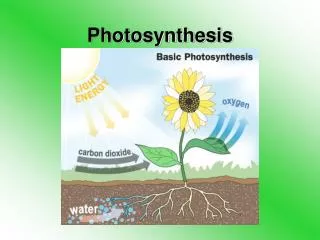
Photosynthesis is the process by which plants convert sunlight into energy using carbon dioxide and water. This vital mechanism involves two key stages: the light-dependent reactions and the Calvin Cycle. ATP (Adenosine triphosphate) acts as the primary energy carrier in cells, storing energy for various functions. The chlorophyll pigment absorbs sunlight while reflecting green light, facilitating the conversion of solar energy into chemical energy. Understanding photosynthesis is crucial for appreciating how energy flows in ecosystems and contributes to life on Earth.

Photosynthesis
E N D
Presentation Transcript
Photosynthesis Unit 6 continued
We need energy • Energy is the ability to do work • Most energy on earth comes from the sun • Heterotrophs get energy by eating other organisms • Autotrophs make their own food and energy photosynthesis = when they use the sun (light energy) as their energy source
How do we store energy? • Chemical bonds are formed = energy is stored • Chemical bonds are broken = energy is released • Adenosine triphosphate (ATP) = main source of energy for cells, provides power for almost all functions • Contains adenine, ribose (5-carbon sugar), and 3 phosphate groups
How do we store energy? • ATP = “charged” battery, stores energy • Energy is released by breaking off the last phosphate group Adenosine diphosphate (ADP) • ADP = “dead” battery, energy has been released
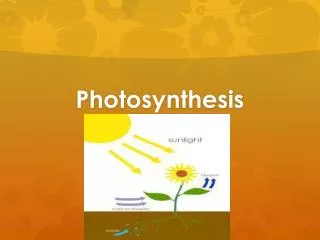
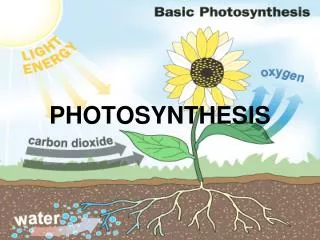
How does photosynthesis work? • Plants use the energy from the sun to convert water and carbon dioxide into oxygen and glucose (sugar) • Joseph Priestly – discovered that plants make oxygen. He placed a lit candle under a jar and waited until it had consumed all the oxygen. He discovered that if he placed a sprig of mint in the jar and waited a few days, the candle could be lit again, indicating that the plant produced oxygen.
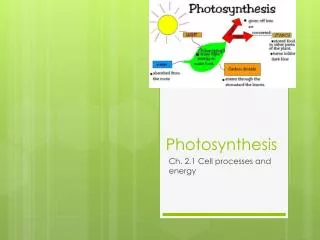
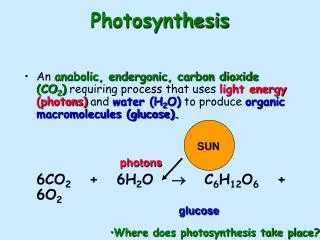
Photosynthesis equation • 6CO2 + 6H2O light> C6H12O6 + 6O2 • Carbon dioxide + water light> glucose + oxygen • Carbon dioxide, water, and light must be present for photosynthesis to occur
What kind of light does photosynthesis need to occur? • Sunlight is “white” light a mixture of different wavelengths of light • Pigment = light-absorbing molecule • Chlorophyll = main pigment of plants, does not absorb green light very well gets reflected back to our eyes
Inside a Chloroplast • Thylakoids = small disc-shaped saclike photosynthetic membranes • Grana = stacks of thylakoids • Stroma = region outside thylakoid membranes
Electron Carriers • Electrons gain a great deal of energy when they are excited by the sun require special carriers • NADP+ (nicotinamide adenine dinucleotide phosphate) = main electron carrier • NADP+ holds 2 high energy electrons and additional hydrogen ion becomes NADPH • NADPH carries electrons to chemical reactions elsewhere in the cell
Two Parts of Photosynthesis • 1. Light-dependent reaction = produces energy from solar power (photons) in the form of ATP and NADPH • 2. Calvin Cycle or Light Independent Reaction • Also called “carbon fixation” or “C3 Fixation” • Uses energy (ATP and NADPH) from light reaction to make glucose
Light Reaction (Electron Flow) • Occurs in thylakoid membranes • During the light reaction, there are 2 possible routes for electron flow: • Cyclic electron flow • Noncyclic electron flow
Cyclic Electron Flow • Occurs in the thylakoid membrane. • Uses Photosystem I only • P700 reaction center- chlorophyll a • Uses Electron Transport Chain (ETC) • Generates ATP only
e- Primary Electron Acceptor SUN e- ATP produced by ETC e- Photons e- P700 Accessory Pigments Photosystem I Cyclic Electron Flow
Noncyclic Electron Flow • Occurs in the thylakoid membrane • Uses Photosystem II and Photosystem I • P680 reaction center (PSII) - chlorophyll a • P700 reaction center (PS I) - chlorophyll a • Uses Electron Transport Chain (ETC) • Generates O2, ATP and NADPH
Primary Electron Acceptor 2e- Enzyme Reaction Primary Electron Acceptor 2e- 2e- ETC 2e- SUN 2e- NADPH P700 Photon ATP P680 Photon H2O 1/2O2+ 2H+ Photosystem I Photosystem II Noncyclic Electron Flow
Noncyclic Electron Flow • ADP + P ATP • NADP+ + H NADPH • Oxygen comes from the splitting of H2O, not CO2 H2O 1/2 O2 + 2H+
Calvin Cycle • Carbon Fixation (light independent reaction) • C3 plants (80% of plants on earth) • Occurs in the stroma • Uses ATP and NADPH from light reaction as energy • Uses CO2 • To produce glucose: it takes 6 turns and uses 18 ATP and 12 NADPH.
(36C) (6C) 6C-C-C-C-C-C (unstable) 6CO2 6C-C-C 6C-C-C 12PGA (36C) 6ATP 6ATP (30C) 6C-C-C-C-C 6NADPH 6NADPH RuBP (36C) 6C-C-C 6C-C-C 6ATP 12G3P (30C) (6C) C-C-C-C-C-C Glucose Calvin Cycle – Carbon Fixation
Factors affecting photosynthesis • Temperature • Availability of water • Light intensity • These factors are different in different areas of the world plants develop special adaptations