
Dynamic Recrystallization and Its Applications in Earth Science: Insights and Challenges
This document explores dynamic recrystallization and its key applications in understanding the rheological behavior of geological materials, particularly relating to partial melting in the lithosphere-asthenosphere structure. Notable studies by Karato, Hirth, and Kohlstedt highlight the depletion of trace elements, including hydrogen, through melting, leading to enhanced hardness in subducted slabs. Additionally, unresolved issues concerning rheological stratification, grain size control, and shear localization in deep mantle minerals are discussed, providing valuable insights into ongoing geological processes.

Dynamic Recrystallization and Its Applications in Earth Science: Insights and Challenges
E N D
Presentation Transcript
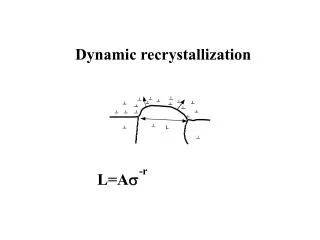
Dynamic recrystallization -r L=As
Some Applications • Dewatering due to partial melting and the lithosphere-asthenosphere structure (Karato (1986); Hirth and Kohlstedt (1996); Karato and Jung (1998)) • Strength and deformation of subducted slabs (Riedel and Karato (1997); Karato et al. (2001))
Partial melting results in depletion of trace elements including hydrogen leading to hardening.
A model of rheological structure of a descending slab in the transition zone Karato et al. (1998) Karato et al. (2001)
Unresolved Problems in Rheology • Rheological stratification: rheology of deep mantle minerals • Lattice-preferred orientation in deep mantle minerals • What controls the grain-size? • What controls the water distribution? • Shear localization • Deformation of a two-phase material
