Understanding Search Engines: Types of Questions and Evaluation Criteria
This guide outlines the fundamental concepts of search engines, including two primary question types: specific and exploratory. It explains key terms such as search expression, boolean operators, and search engine functions (like web robots and meta search engines). Additionally, it details five traditional evaluation criteria for web resources: accuracy, authority, objectivity, currency, and coverage. By mastering these concepts, users can enhance their web searching skills and assess the reliability of information obtained online.

Understanding Search Engines: Types of Questions and Evaluation Criteria
E N D
Presentation Transcript
Searching the Web VCCS Commonwealth Course
Two types of Questions on a Search Engine: • Specific Question: easily phrased question with an answer that is quickly recognized. Example: • What is the population of VA? • Exploratory Question: an open ended question that is hard to determine the answer. Example: • What started the Gulf War?
Search Engine • A special that kind of web page that finds other web pages that match a word or phrase that you have entered.
Search Expression • The word or phrase that you type in. • Also called a query
Other Terms in Search Engines • Hit: a web site that was found in the search engine’s database. • Results Page: Hyperlinks page to the web pages that match.
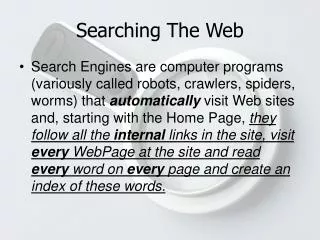
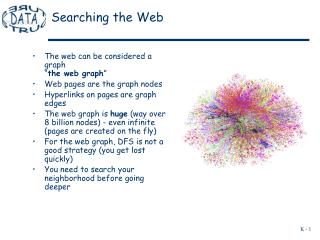
Web Robot • Called a bot or spider • A program that automatically searches the web to find new web sites and to update old ones.
Meta Search Engine • A search engine that combines the power of multiple search engines.
Boolean Operators • AND – all must be true • OR – at least one must be true • NOT – excludes that word
Wildcard Operator • * is the wildcard operator. • If you typed treat*, the search engine would find treaty, treatment, treats, treaties *
Five Traditional Evaluation Criteria • Accuracy • Authority • Objectivity • Currency • Coverage
Criterion #1: Accuracy • How reliable and free from error is the information? • Are there editors and fact checkers? • OncoLink (http://oncolink.upenn.edu) • Tobacco Control Archives (http://www.library.ucsf.edu/tobacco/index.html) • The Onion (http://www.theonion.com)
Accuracy of Web Resources • Almost anyone can publish on the Web • Many Web resources not verified by editors and/or fact checkers • Web standards to ensure accuracy not fully developed
Criterion #2: Authority • What are the author’s qualifications for writing on the subject? • How reputable is the publisher?
Authority of Web Resources • Often difficult to determine authorship of Web resources • If author’s name listed, his/her qualifications frequently absent • Publisher responsibility often not indicated
Criterion #3: Objectivity • Is the information presented with a minimum of bias? • To what extent is the information trying to sway the opinion of the audience? • The National Right to Life Committee (http://www.nrlc.org) • NARAL (National Abortion and Reproductive Rights Action League) (http://www.naral.org) • Consumer Reports Online (http://www.consumerreports.org)
Criterion #4: Currency • Is the content of the work up-to-date? • Is the publication date clearly indicated? • USA Today (http://www.usatoday.com) • Webster's Revised Unabridged Dictionary, 1913 Edition (http://humanities.uchicago.edu/forms_unrest/webster.form.html
Currency of Web Resources • Dates not always included on Web pages • If included, a date may have various meanings: • Date first created • Date placed on Web • Date last revised
Criterion #5: Coverage • What topics are included in the work? • To what depth are topics explored? • The "Alternative" White House (http://www.whitehouse.net) • The Official White House (http://www.whitehouse.gov)