Understanding DNA Structure and Key Discoveries in Molecular Biology
This educational content explores the structure of DNA, including its fundamental components such as sugars, phosphates, and nitrogenous bases, as well as the historical contributions of notable scientists like Watson, Crick, and Franklin. Key concepts such as nucleotide structure, macromolecules, and the methods of studying DNA, including centrifugation, are addressed through interactive questions that challenge the learner’s comprehension. Delve into the foundational knowledge of genetics and molecular biology that has shaped our understanding of heredity.

Understanding DNA Structure and Key Discoveries in Molecular Biology
E N D
Presentation Transcript
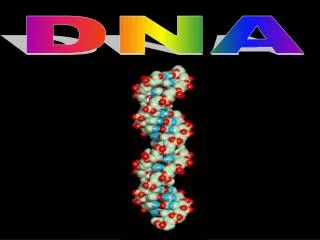
DNAH DNAH DNA Who is that doggy in the window
What is the arrow pointing to? • Sugar • Phosphate • Nitrogenous base • Hydrogen bond
What is the arrow pointing to? • Sugar • Phosphate • Nitrogenous base • Hydrogen bond
What is the circled nucleotide? • Deoxyguanosinemonophosphate • Deoxycytidinemonophosphate • Deoxythymidinemonophosphate • Deoxyadenosinemonophosphate
Which is the 1’ carbon? 4 • 1 • 2 • 3 • 4 1 3 2
Which is the 3’ carbon? 4 • 1 • 2 • 3 • 4 1 3 2
What is this nucleotide? • Deoxyguanosinetriphosphate • Deoxycytidinemonophosphate • Deoxythymidinetriphosphate • Deoxyadenosinemonophosphate
What macromolecule contains C, H, N, O and P • Nucleic acid • Carbohydrate • Amino Acid • Nucleotide • Sugar • Protein
What macromolecule contains C, H, N, O and S • Nucleic acid • Carbohydrate • Amino Acid • Nucleotide • Sugar • Protein
Where would you find sulfur? • 1 • 2 2 1
What do you call area Z after centrifugation? • Heavy stuff • Pellet • Superskinny • Supernatant • Wonder Woman Z
Where would you find phosphorus? • 1 • 2 2 1
If we centrifuged many E. coli’s and bacteriophages for 5 minutes, what would be found in the pellet? • Bacteriophages only • E. coli only • Both bacteriophages and E. coli • Neither bacteriophages or E. coli E. coli
If you allowed bacteriophages tagged with radioactive phosphorus to infect E. coli and then centrifuged, what would be radioactive after centrifugation. • Bacteriophage and supernatant • Bacteriophages and pellet • E. coli and supernatant • E. coli and pellet E. coli
Who are these loverly people? • Watson and Crick • Watson and Rosalind Franklin • Hershey and Chase • Mrs. Zurawski and Mr. Pehanic • Your parents!
What is the major scientific achievement of Fredrick Griffith in 1928? • Defined DNA as a transforming factor • Declared that chromosomes control heredity • Stated that dead bacteria can somehow change living bacteria • Used radioactive tagged bacteriophages to support the idea that DNA is the hereditary material • Declared that DNA is replicated semi-conservatively
Who are these loverly people? • Watson and Crick • Watson and Rosalind Franklin • Hershey and Chase • Mr. Woods and Mr. Iwan • Your parents!
Who’s work is best represented by the graph below? • Watson and Crick • Rosalind Franklin • Hershey and Chase • Erwin Chargaff • Linus Pauling
Who is this handsome devil? • Francis Crick • Erwin Chargaff • James Watson • Alfred Hershey • Mr. Grimm’s grandfather
Who’s work proved that the DNA has the same width throughout the length of the molecule • Watson and Crick • Rosalind Franklin • Hershey and Chase • Erwin Chargaff • Linus Pauling