Understanding Energy Transformations and Conservation in Roller Coasters
90 likes | 224 Vues
This section explores the concepts of potential energy (PE) and kinetic energy (KE) in roller coasters, illustrating the conservation of energy principle. At the top of a hill, potential energy is maximized while kinetic energy is at zero. As the coaster descends, all the potential energy converts to kinetic energy. The fundamental law of conservation of energy states that energy cannot be created or destroyed, only transformed. We also discuss the efficiency of machines, highlighting energy loss due to sound, friction, and air resistance, impacting useful work output.


Understanding Energy Transformations and Conservation in Roller Coasters
E N D
Presentation Transcript
Section 4 Conservation of Energy
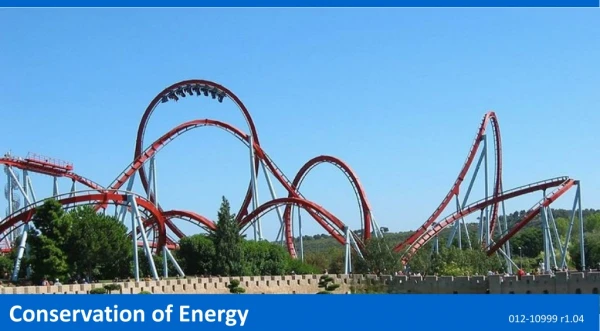
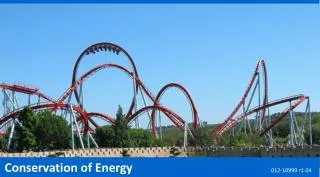
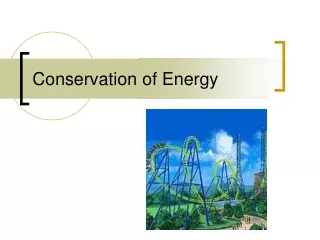
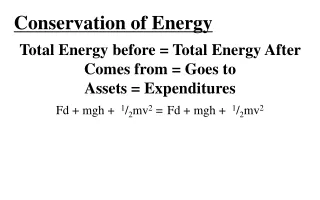
I. Energy Transformations At the top of the hill, PE is at it’s maximum. What about KE? KE = 0.0 J PE = mgh PE = (515 kg)(9.8 m/s2)(70.0 m) PE = 353,290 J
I. Energy Transformations At the bottom of the hill, KE is at it’s maximum. What about PE? PE = 0.0 J KE = ½mv2 KE = ½(515 kg)(37.1)2 All of the PE was converted to KE. KE = 353,290 J
As the car reaches the top of the 2nd hill, KE = PE. KE = ½mv2 KE = ½(515 kg)(26.2)2 PE = mgh PE = (515 kg)(9.8 m/s2)(35.0 m) KE = 176,758 J PE = 176,645 J
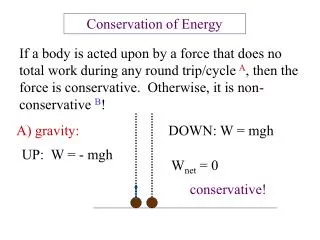
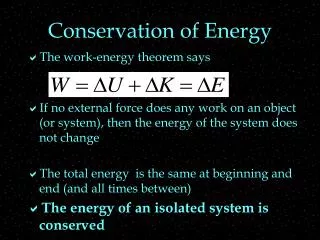
II. The Law of Conservation of Energy Energy cannot be created or destroyed. 1. Energy changes from one form to another Roller coasters lose energy through: Sound Friction Air Resistance
III. Efficiency of Machines Not all work done by a machine is useful 1. Work Input is not equal to Work Output Energy is lost through: Sound Friction Air Resistance
Example: With this pulley system, we should be able to lift 100 pounds with only 25 pounds of force. However, friction and heat would cause some of the input force (25 lbs.) to be lost.
Sample problems pg. 407 Questions 1 – 3