Understanding Waves and Sound: Nature, Speed, and Human Perception
This text explores the fascinating nature of sound, detailing how it travels at 344 m/s in air at 20°C and the factors affecting its speed, such as medium type and temperature. It delves into human hearing, explaining how sound waves vibrate the eardrum, their conversion into nerve impulses, and the concepts of pitch and intensity measured in decibels. The Doppler effect is also discussed, showcasing how a moving sound source alters its frequency, and the applications of ultrasonic waves in medical imaging and sonar technology.

Understanding Waves and Sound: Nature, Speed, and Human Perception
E N D
Presentation Transcript
Ch. 18 - Waves & Sound II. The Nature of Sound • Speed of Sound • Human hearing • Doppler effect • Seeing with sound
A. Speed of Sound • 344 m/s in air at 20°C • Depends on: • Type of medium • travels better through liquids and solids • can’t travel through a vacuum • Temperature of medium • travels faster at higher temps
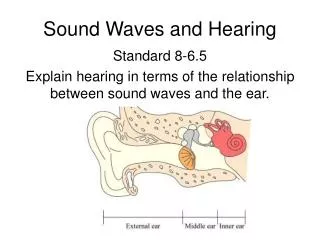
B. Human Hearing sound wave vibrates ear drum amplified by bones converted to nerve impulses in cochlea
B. Human Hearing • Pitch • highness or lowness of a sound • depends on frequency of sound wave • human range: 20 - 20,000 Hz ultrasonic waves subsonic waves
B. Human Hearing • Intensity • volume of sound • depends on energy (amplitude) of sound wave • measured in decibels (dB)
B. Human Hearing DECIBEL SCALE 120 110 100 80 70 40 18 10 0
C. Doppler Effect • Doppler Effect • change in wave frequency caused by a moving wave source • moving toward you - pitch sounds higher • moving away from you - pitch sounds lower
lower frequency higher frequency C. Doppler Effect Stationary source Moving source Supersonic source waves combine to produce a shock wave called a sonic boom same frequency in all directions
Medical Imaging SONAR “Sound Navigation Ranging” D. Seeing with Sound • Ultrasonic waves - above 20,000 Hz