
Kinetics and Electromyography Changes in Wheelchair Propulsion at Varying Speeds
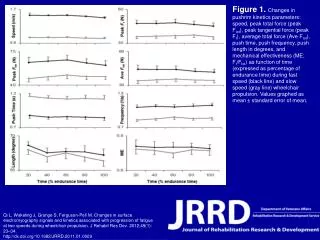
This study examines the variations in pushrim kinetics parameters during wheelchair propulsion at both fast and slow speeds. Key metrics analyzed include speed, peak total force, peak tangential force, average total force, push time, frequency, push length, and mechanical effectiveness, all represented as a function of time as a percentage of endurance time. The findings provide insights into the mechanical impacts of fatigue on performance as indicated by surface electromyography signals. The results are crucial for enhancing rehabilitation practices for wheelchair users.

Kinetics and Electromyography Changes in Wheelchair Propulsion at Varying Speeds
E N D
Presentation Transcript
Figure 1. Changes in pushrim kinetics parameters: speed, peak total force (peak Ftot), peak tangential force (peak Ft), average total force (Ave Ftot), push time, push frequency, push length in degrees, and mechanical effectiveness (ME; Ft/Ftot) as function of time (expressed as percentage of endurance time) during fast speed (black line) and slow speed (gray line) wheelchair propulsion. Values graphed as mean ± standard error of mean. Qi L, Wakeling J, Grange S, Ferguson-Pell M. Changes in surface electromyography signals and kinetics associated with progression of fatigue at two speeds during wheelchair propulsion. J Rehabil Res Dev. 2012;49(1): 23–34.http://dx.doi.org/10.1682/JRRD.2011.01.0009
