Intermolecular Forces
Intermolecular forces are weak attractions between individual molecules that play a crucial role in the properties of substances. These forces include London Dispersion Forces (LDFs), observed in all polar and nonpolar substances, which are the weakest and depend on molecular mass—larger molecules exhibit stronger dispersion forces. Additionally, dipole-dipole interactions occur in polar substances, being slightly stronger than LDFs. Hydrogen bonding, a special dipole interaction, occurs between hydrogen and highly electronegative atoms like nitrogen, oxygen, or fluorine, making it the strongest of the intermolecular forces.

Intermolecular Forces
E N D
Presentation Transcript
Intermolecular Forces • weak forces of attraction between individual molecules • What holds molecules to each other
London Dispersion ForcesLDFs • Seen in all substances, polar and nonpolar • Weakest intermolecular force • Depend on molecular mass • More mass means stronger dispersion forces • Bigger molecules have more electrons, stronger dispersion forces
Dipole interactions(a.k.a. dipole-dipole) • Seen in polar substances • Occur when polar molecules are attracted to each other • Slightlystronger than LDFs
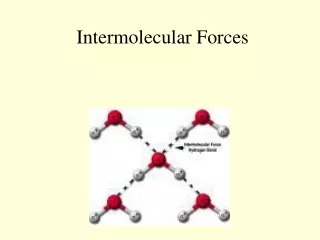
Hydrogen bonding • A special type of dipole interaction • Only seen between H and N, O, or F • Strongest of the IMFs because F, O, and N are very electronegative
H O O H H O H H H H O H H H H O O O H H H Hydrogen bonding