Where Ideas Come From
Dive into the vibrant world of Bill Watterson's "Calvin and Hobbes," where the heat of summer ignites relatable experiences of childhood humor. This discussion focuses on Calvin’s exaggerated struggles with the heat, illustrating the water cycle through a comedic lens. We explore various books tailored for different ages, from Munsch's "Mortimer" for younger audiences to Tolkien's "The Hobbit" for older students, emphasizing the importance of relatable characters, themes, and humor in storytelling. Learn how to spark creativity in your own writing and use feelings and exaggeration to captivate your readers.

Where Ideas Come From
E N D
Presentation Transcript
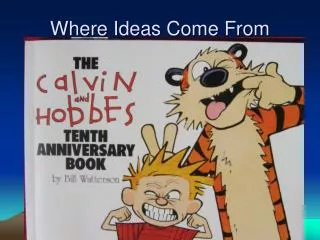
Discussion of Bill Watterson’s cartoon Calvin and Hobbes • Ever feel so hot you thought you might melt? Many people have. This is a shared experience. • See the water cycle? Science is used in the story. • Humor is used, when Calvin cools down and feels natural/normal.
Book Discussions • Depending on age, I discuss where ideas come in a variety of books. For younger students: Mortimer by Munsch, Shortcut by D. Crews, Fuzz Frenzy by Stevens & Hummel. • Older students: War of the Worlds by HG Wells, The Hobbit by JRR Tolkien, Jonathan Livingston Seagull by R. Bach, Phantom Tollbooth by Norton Juster.
From real life to stories: • Use relatable characters to target your audience. • Use relatable themes and conflicts, age appropriate. • Exaggerate. • Use feelings. • Use humor.
How William Hill’s imagination works • I discuss where the ideas came from in one of my books, from The Magic Bicycle, to The Vampire Hunters or Dragon Pawns.
Who trains wizards’ familiars? What if there was an academy?What if a wizard had a dragon-like temper?