Bridging the Geoscientist Gap in the U.S. Petroleum Industry
This study analyzes the disparity between U.S. geoscience graduates and the number necessary for the petroleum industry. By assuming technological advancements and industry trends, it quantifies the "Gap 1%" and provides valuable insights. Sources include NSF, AGI, and Katz & Claudy (2000).

Bridging the Geoscientist Gap in the U.S. Petroleum Industry
E N D
Presentation Transcript
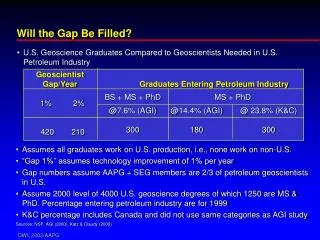
Will the Gap Be Filled? • U.S. Geoscience Graduates Compared to Geoscientists Needed in U.S. Petroleum Industry • Assumes all graduates work on U.S. production, i.e., none work on non-U.S. • “Gap 1%” assumes technology improvement of 1% per year • Gap numbers assume AAPG + SEG members are 2/3 of petroleum geoscientists in U.S. • Assume 2000 level of 4000 U.S. geoscience degrees of which 1250 are MS & PhD. Percentage entering petroleum industry are for 1999 • K&C percentage includes Canada and did not use same categories as AGI study Sources: NSF, AGI (2000), Katz & Claudy (2000) Geoscientist Gap/Year Graduates Entering Petroleum Industry BS + MS + PhD MS + PhD @7.6% (AGI) @14.4% (AGI) @ 23.8% (K&C) 300 180 300 1% 2% 420 210