Enhancing Remote User Authentication in Chemistry: A Comprehensive PKI Approach
This document outlines a robust Public Key Infrastructure (PKI) framework for the Chemistry community, addressing the authentication needs of remote users. Key requirements include ease of operation for chemists, strong security protocols, and compatibility with existing systems like NCS. Highlights include a well-defined Certification Policy (CP), Certificate Practice Statement (CPS), and lessons learned from the implementation and user education components. By focusing on risk assessment and rigorous credential verification, the framework aims to bolster security across academic and research environments.

Enhancing Remote User Authentication in Chemistry: A Comprehensive PKI Approach
E N D
Presentation Transcript
Comb-e-Chem PKI Mike Surridge, Steve Taylor IT Innovation
Public Key Infrastructure(PKI) • Requirements: • be able to authenticate remote users • be easy to operate by Chemists (e.g. NCS) • be secure enough for academic users • Analysis of existing NCS authentication: • uses personal knowledge of user community • uses contextual information (e.g. EPSRC project codes) • lightweight for both NCS and their customers • Public key infrastructure developments: • Comb-e-Chem certification policy agreed • procedures developed for NCS to certify remote users • operational responsibility transferred to Chemistry
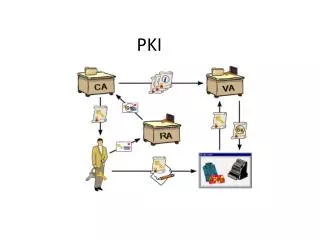
PKI Roles • Grid community • defines security policy and certificate policy (CP) • approves certification authorities • Certification Authority (CA) • defines certification practise statement (CPS) • engages registration authorities • issues certificates in accordance with policy • Registration Authority (RA) • checks credentials of certificate applicants • enforces security and certificate policy
Comb-e-Chem CP • CP is Certification Policy • a set of rules by which a PKI must operate • follows a format described in RFC2527 • areas such as user registration, physical security, certificate life cycle, etc… • Comb-e-Chem CP pays particular attention to • user registration • certificate life cycle
NCS CPS • CPS is Certificate Practice Statement • A description of how the NCS CA (Sam) abides by and implements the rules in the CP • describes operational procedures for implementing the CP’s requirements • contains a number of agreement forms to be signed by the parties involved
PKI - Lessons Learned • The PKI must have well-defined procedures and strict adherence to them • CP & CPS • The CA must exercise rigour in operational procedures • checking of credentials • following procedures to the letter • physical security • audit trails • backups • revocation
PKI - Lessons Learned 2 • User education must be addressed • the concepts of PKI are complex • the overhead of education can be a barrier to take-up • ill-informed users can worsen security • do users understand what is meant by (for example) a private key and a certificate? • do they understand their security obligations? • in the NCS case, users are guided by the RA
Comb-e-Chem Security Mike Surridge, Steve Taylor IT Innovation
Overview of Activities • Security risk management • applied to the NCS service • Security implementation • operating policies and public key infrastructure • deployment of security features at NCS
Asset-Based Security Risk Analysis Risk Management Identify and value assets Define risk management approach Identify threats and risks Implement defences Identify and cost defences
Risk Analysis • Value assets based on impact of compromise • high: likely to cause total business failure • med: significant but not fatal impact • low: irritating but no significant impact • Threats based on likelihood of attack • high: attacks will definitely take place • med: attacks may occur from time to time • low: attacks are unlikely • Risks based on likelihood of success • taking account of existing defences
Risk Management • Determine appropriate response to threats • acceptance: live with the potential consequences • reduction: introduce defences • avoidance: don’t use the system • Leads to cost-effective security • as much security as you need • not more than you can afford
Application to NCS Service • Assets: • campus system and network integrity (med/high) • sample tracking data (med) • experimental result data (low/med) • grid service integrity (low/med) • Risks: • system attacks from outside campus (high likelihood) • systems attacks from inside campus (med likelihood) • compromise of remote user credentials (high likelihood) • internal user error (med likelihood)
Conclusions • Progress with core technology developments • authorisation and WS-Security • relevant for service integration • NCS security risks analysed • appropriate defences identified • Security procedures and infrastructure implemented • public key infrastructure (CA, RAs, policies) • firewalls and protocols for NCS deployment
Comb-e-Chem Security Mike Surridge, Steve Taylor IT Innovation
Conclusions • Progress with core technology developments • authorisation and WS-Security • relevant for service integration • NCS security risks analysed • appropriate defences identified • Security procedures and infrastructure implemented • public key infrastructure (CA, RAs, policies) • firewalls and protocols for NCS deployment
CA1 CAn User Resource User Resource PKI can have Multiple CAs