
Energy Harvesting
E N D
Presentation Transcript
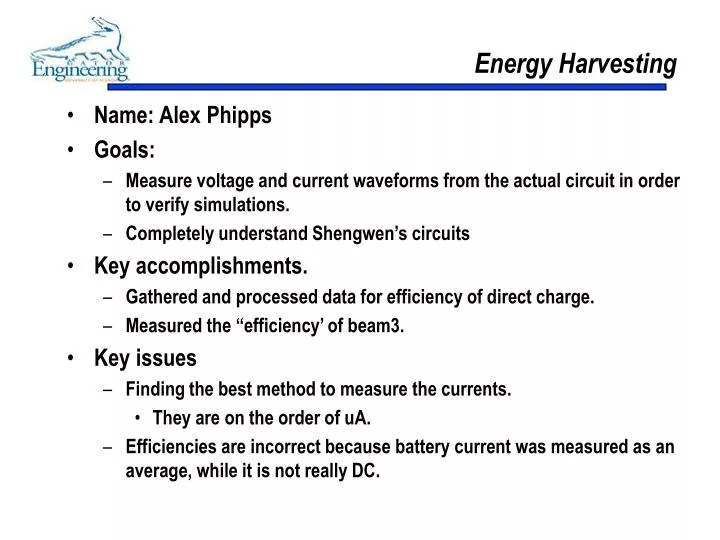
Energy Harvesting • Name: Alex Phipps • Goals: • Measure voltage and current waveforms from the actual circuit in order to verify simulations. • Completely understand Shengwen’s circuits • Key accomplishments. • Gathered and processed data for efficiency of direct charge. • Measured the “efficiency’ of beam3. • Key issues • Finding the best method to measure the currents. • They are on the order of uA. • Efficiencies are incorrect because battery current was measured as an average, while it is not really DC.
Measurements • Efficiency vs. Input Force can be seen for beam3. • This is the electrical efficiency for the direct charger. • For a 2V Vbattery • There is a 1kohm in the input current path • This will lower efficiency The shapes should be correct, but the magnitude of the efficiency is not. • The output current was measured as the average and not the RMS. • Output power is therefore low and so is efficiency.
Next Experiment • Desired measurements • Beam deflection will be measured with the displacement sensor. • This allows mechanical input power (P = Fd) to be found and efficiency through all stages. • RMS current into the battery needs to be measured. • This will be done by measuring the voltage across a resistor. • This process will bring more loss to the system, so it may or may not increase efficiency.