Perspectives on Forest-Based Bioenergy and Its Climate Impact
This document examines the timing and benefits of forest-based bioenergy, highlighting its role in climate change, costs associated with carbon emissions, and the critical need for immediate action to limit global temperature rise. It discusses various forest management practices, the implications of forest-derived bioenergy on greenhouse gas mitigation, and the concept of carbon debt associated with biomass production. A thorough analysis of land use changes and life cycle assessments emphasizes the complexities and uncertainties involved in bioenergy production and its long-term sustainability.

Perspectives on Forest-Based Bioenergy and Its Climate Impact
E N D
Presentation Transcript
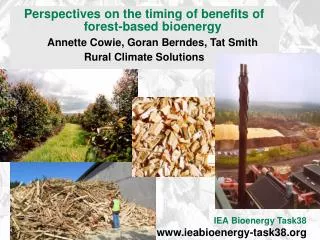
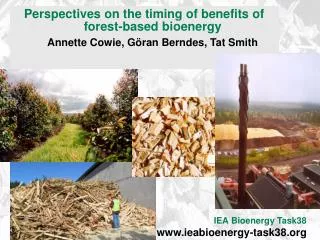
Perspectives on the timing of benefits of forest-based bioenergy Annette Cowie, Göran Berndes, Tat Smith As of September 2001 Page 1 ISO 9001 certified IEABioenergy Task38 www.ieabioenergy-task38.org
Costs of climate change In 2010, climate change cost: • 700 billion USD • 0.9% global GDP • 400,000 deaths per year – 90% children Climate change + Carbon economy • costs 1.2 trillion USD • kills 4.975 million DARA, 2012
Too late to avoid 2° C ? • 2° C: target of the Copenhagen Accord to avoid catastrophic outcomes • Already increased by 1 degree • At least 0.5 degree unavoidable – in train • Without immediate and drastic action we cannot meet the 2° C target
Negative emissions options • Afforestation, soil carbon management • Enhanced weathering • Direct air capture • Ocean fertilisation • “BECCS” – Bioenergy+ Carbon Capture &Storage
Atmosphere Bioenergy – “carbon neutral”
“Carbon debt” papers • Holtsmark, B. (2012). “Harvesting in boreal forests and the biofuel carbon debt.” Climatic Change 112(2): 415-428. • Hudiburg, T. W., Law B. E., Wirth C. and Luyssaert S. (2011). “Regional carbon dioxide implications of forest bioenergy production.” Nature Clim. Change 1(8): 419-42 • LamersP., Junginger M., (2013) " The ‘debt’ is in the detail: a synthesis of recent temporal forest carbon analyses on woody biomass for energy." Biofuels, Bioproducts, and Biorefining, in press. • McKechnie, J., S. Colombo, J. Chen, W. Mabee and H. L. MacLean (2011). “Forest bioenergy or forest carbon? Assessing trade-offs in greenhouse gas mitigation with wood-based fuels.” Environmental Science and Technology 45(2): 789-795. • Schulze, E.-D., C. Körner, B. E. Law, H. Haberl and S. Luyssaert (2012). “Large-scale bioenergy from additional harvest of forest biomass is neither sustainable nor greenhouse gas neutral.” GCB Bioenergy: 4(6): 611-616. • Searchinger, T et al(2009). “Fixing a critical climate accounting error.” Science 326(5952): 527-528. • Walker, T et al (2010). Massachussets Biomass Sustainability and Carbon Policy Study. Manomet Center for Conservation Sciences. • Zanchi, G., N. Pena and D. N. Bird (2010). The upfront carbon debt of bioenergy. Graz, Austria, Joanneum Research.
IEA Bioenergy Task 38 • “Climate change effects of biomass and bioenergy systems” • Participating countries: • Australia, Brazil, Finland, France, Germany, Netherlands, Norway, Sweden, USA
Objectives of Task 38 • Develop, demonstrate and promote standard methodology for GHG balances • Increase understanding of GHG outcomes of bioenergy and carbon sequestration • Emphasise overall atmospheric impact, whole life cycle • Promote international exchange of ideas, models and scientific results • Aid decision makers in selecting most effective mitigation options
Timing statement published July 2013 ieabioenergy.com/iea-publications/ Annette Cowie, Göran Berndes, Tat Smith and others from Tasks 38, 40 and 43
Consider carbon stock change • “direct land use change dLUC” • change in land use or management affects C in biomass and soil
Indirect landuse change • Outside system boundary • Form of “leakage” • Off-site carbon stock change, methane, nitrous oxide emissions • logging • fire • drainage of peatlands
Reference energy system • Fossil energy source: average or marginal? • Conversion efficiency Displacement factor = efficiencybio /efficiencyrefx CO2ref/CO2bio • Nearly always <1
Reference land use • Natural forest • Integrated food/feed/timber/biomass systems
Spatial scale? F Cherubini NTNU
Different perspectives • Stand vs landscape • Individual operator vs national government • Natural system vs managed system • Clock starts at planting vs at harvest • Short term vs long term • Specific stage vs whole life cycle • Biomass only vs integrated forest product system • Average vs marginal reference system • Debt vs investment
JRC report http://iet.jrc.ec.europa.eu/bf-ca/sites/bf-ca/files/files/documents/eur25354en_online-final.pdf
JRC report • Negative conclusion for forest-based bioenergy – too uncertain therefore too risky • Ignores forest management impacts on forest growth • Accepts as reference “natural carbon carrying capacity” without human intervention • Focus on short term “carbon neutrality”
IEA Bioenergy Statement: • Policymakers need to consider the big picture - the whole life cycle, the long term, human influences • Biomass for energy is usually one of several products from a managed forest • Forest C stocks fluctuate (at the stand level) over time and space- a forest is a mosaic of age classes • Forest C stock should be considered across the estate • A function of management and natural factors • May be increasing or decreasing or stable
IEA Bioenergy Statement: • If C stock decreases (relative to “without bioenergy” scenario), this is an emission that must be compensated through avoiding fossil fuels, before bioenergy gives net mitigation benefit • Loss in C stock can be minimised by investment in intensive forest management • GHG cost is an investment in establishing renewable energy system