Understanding Matter and Energy: Solids, Liquids, Gases, and Heat Transfer
100 likes | 282 Vues
This informative text delves into the fundamental concepts of matter and energy, explaining the characteristics of solids, liquids, and gases. Solids have a definite shape and occupy a fixed amount of space, while liquids take the shape of their container but maintain a constant volume. Gases, in contrast, have no definite shape or volume. The text also explores heat transfer methods: convection, where hot air rises due to lower density; conduction, the transfer of thermal energy through direct contact; and the role of solar energy as a vital resource.


Understanding Matter and Energy: Solids, Liquids, Gases, and Heat Transfer
E N D
Presentation Transcript
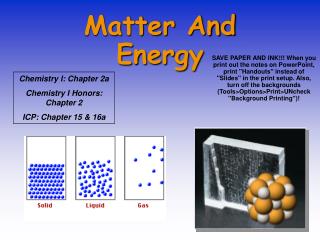
Solids • Matter that has a definite shape and takes up a definite amount of space.
Liquids • Matter that takes the shape of the container and takes up a definite amount of space.
Gas • Matter that has no definite shape and takes up no definite amount of space. helium Water vapor
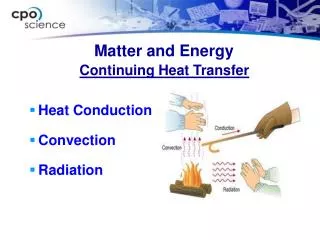
Convection Air near a hot object gets hot and takes up more space. Because the hot air is less dense, it is forced up by the cooler, denser air around it.
Radiation Energy that moves through matter and empty space is called Radiation.
Conduction • Thermal energy moves from an electric stove burner to a metal pot by Conduction • Conduction happens every time you grab something hot or cold.
Fuel • Any material that can burn.
Solar Energy • Energy given off by the Sun.