Download
1 / 1
10 likes | 157 Vues
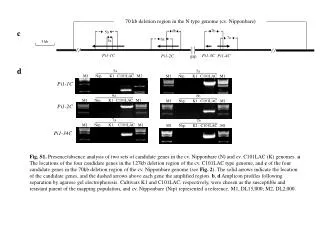
This study investigates the presence and absence of candidate genes within the 70 kb deletion region of the Nipponbare genome and the 127 kb deletion region of the C101LAC genome. Utilizing agarose gel electrophoresis, we profile the amplicons of selected cultivars to map gene locations. The aim is to understand the genetic differences between susceptible (C101LAC) and resistant (Nipponbare) rice varieties. This research contributes to our understanding of how genomic deletions impact gene function and resistance traits in rice.

E N D
7b 7a 6b 6a 5a 5a M1 Nip. K1 C101LAC M1 M1 Nip. K1 C101LAC M1 M1 Nip. K1 C101LAC M1 M1 Nip. K1 C101LAC M1 M1 Nip. K1 C101LAC M2 M1 Nip. K1 C101LAC M1 70 kb deletion region in the N type genome (cv. Nipponbare) 7b c 6b 5b 7a 6a 5a 5 kb Pi1-1C Pi1-3C Pi1-4C Pi1-2C gap d Pi1-1C Pi1-2C Pi1-34C Fig. S1. Presence/absence analysis of two sets of candidate genes in the cv. Nipponbare (N) and cv. C101LAC (K) genomes. a The locations of the four candidate genes in the 127kb deletion region of the cv. C101LAC type genome, and c of the four candidate genes in the 70kb deletion region of the cv. Nipponbare genome (see Fig. 2). The solid arrows indicate the location of the candidate genes, and the dashed arrows above each gene the amplified region. b, d Amplicon profiles following separation by agarose gel electrophoresis. Cultivars K1 and C101LAC, respectively, were chosen as the susceptible and resistant parent of the mapping population, and cv. Nipponbare (Nip) represented a reference. M1, DL15,000; M2, DL2,000.