Download
1 / 24
240 likes | 352 Vues
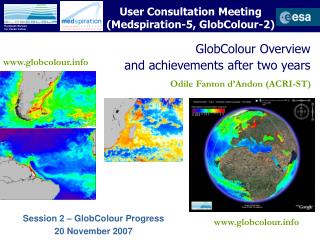
This study explores the current ocean color merged data sets and the methodologies used for merging, focusing on products from REASoN (ICESS/UCSB), NASA OBPG, and GlobCOLOUR. It evaluates coverage, time-series data, matchups with in situ data, frequency distributions, and error estimates. The findings highlight that GlobCOLOUR offers better daily coverage and product consistency than individual sensors, while addressing specific issues like high chlorophyll (CHL) values from MERIS and BBP products. Overall, the three data sets exhibit strong agreement.

E N D
Comparisons of ocean colour merged data sets Stéphane Maritorena ICESS University of California, Santa Barbara Special thanks to Odile, Antoine and the ACRI-ST Team
OUTLINE • Current Ocean Colour merged data sets and associated merging techniques and products. • Coverage • Time-series • Matchups • Frequency distributions • Error estimates
Ocean Color Merged Data Sets • REASoN (ICESS/UCSB) • NASA OBPG • GlobCOLOUR
Daily coverage using SeaWiFS/Aqua and Meris (2003 data) GlobCOLOUR NASA REASoN
FREQUENCY OF COVERAGE (2005) Days Merged SeaWiFS Aqua
Relative contribution of each sensor to an 8-Day composite MERIS AQUA SeaWiFS
Issues with the particulate backscattering product Meris issue Mostly a SeaWiFS issue • Noise in the SeaWiFS Lwn() around gaps caused by clouds. In these areas, the Lwn() are sometimes higher than in nearby gap-free areas and this results in enhanced bbp (443) values. • Problem does not exist in Aqua data • MERIS shows some stripes of high BBP values on some swaths.
Matchups - CHL In situ data set (NOMAD + SeaBASS) with CHL: ~3100 stations CDM: ~700 stations BBP: ~180 stations Same day matchups, 3x3 box, 9 km data (4.5 km for GlobCOLOUR).
BBP CDM GlobCOLOUR REASoN
Monthly Chlorophyll May 2006
Error estimates at pixel level (%) Chla – May 2006 100% 50% 0%
Summary • The GlobCOLOUR data set provides better daily coverage thanks to the use of the MERIS data. • GlobCOLOUR also offers more products and several resolutions. • CHL • The three merged data sets are very consistent most of the time, except in coastal zones (Z < 1000 m). • MERIS alone tends to produce higher CHL values than SeaWiFS or AQUA. • AQUA alone tends to produce lower CHL values than SeaWiFS or MERIS
Summary (Cont’d) • CHL (Cont’d) • The REASoN and GlobCOLOUR (GSM) data contain less low CHL values than the NASA OBPG data. Also true for REASoN at high CHL values but better agreement in summer. • CDM • The agreement between the GlobCOLOUR and REASoN merged CDM products is excellent, always, everywhere. • BBP • SeaWiFS and MERIS BBP products are sometimes very (too) high. MODIS-AQUA BBP product appears more stable and reasonable.
Conclusion • The three merged data sets look good and are in good agreement overall. • Better agreement between the merged products than between the products from the individual sensors. • Some issues exist (BBP mostly) that need to be looked at.