
Understanding PulsarMon's Output: Gaussian Processes and Non-Central Chi-Square Distribution
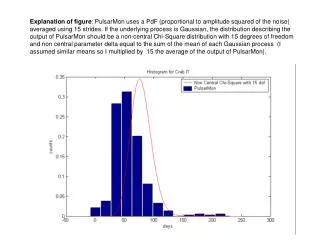
PulsarMon employs a proportional noise model, averaging noise squared over 15 strides. In cases where the underlying process adheres to Gaussian characteristics, the resulting distribution from PulsarMon should manifest as a non-central Chi-Square distribution, characterized by 15 degrees of freedom. The non-central parameter, delta, represents the cumulative mean of each Gaussian input process. This relationship assumes uniform means across inputs, simplifying to a product of 15 times the average output of PulsarMon.

Understanding PulsarMon's Output: Gaussian Processes and Non-Central Chi-Square Distribution
E N D
Presentation Transcript
Explanation of figure: PulsarMon uses a PdF (proportional to amplitude squared of the noise) averaged using 15 strides. If the underlying process is Gaussian, the distribution describing the output of PulsarMon should be a non-central Chi-Square distribution with 15 degrees of freedom and non central parameter delta equal to the sum of the mean of each Gaussian process (I assumed similar means so I multiplied by 15 the average of the output of PulsarMon).