Mutants and Disease
This workshop delves into the diverse types of mutations, from spontaneous to induced, exploring their roles in gene expression and associated phenotypes. Key topics include heritable DNA changes, the influence of mutagens (environmental and chemical), and the significance of gene mutations in understanding protein interactions and cellular development. The lecture also covers case studies like Dwarfing in plants linked to gibberellic acid and Xeroderma Pigmentosa, a condition resulting from DNA repair defects. Participants will learn about mutation detection methods and their implications in genetics and disease research.

Mutants and Disease
E N D
Presentation Transcript
Mutants and Disease MUPGRET Workshop
Mutation • Heritable change in the DNA sequence. • Naturally occurring • Induced
Types of mutations • Chromosomal • Point • Insertion/Deletion • DNA repair
Mutagens • Environmental • Chemical
Mutations as a tool • Associating a phenotype with a gene. • Understanding gene function. • Studying protein interactions. • Understanding cell lineage and organ development.
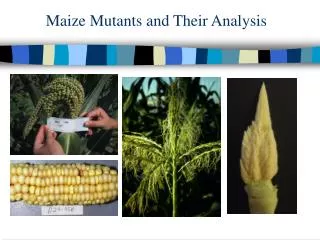
Associating a phenotype with a gene • Changes in the DNA sequence that non-functional or reduced function proteins often cause a visible change in the appearance of the organism. • Some changes do not give visible phenotypes. • Often identified as an “off-type” in plant species.
Cell may not be able to follow damaged instruction OR Damaged protein is made OR Spelling error may be harmless X X Damaged protein may or may not be able to function in the cell. Cell does not make the protein Functional protein made by the cell Misspelled Genes: 3 Possible Outcomes DNA A misspelled gene
Dwarfing • Gibberellic acid (GA) is a plant hormone. • GA levels influence growth. • Mutants in genes for GA synthesis, reduce plant height.
Associating a phenotype #2 • This is often the first step towards understanding the function of a gene or to dissecting a biochemical pathway. • The mutation can be either a naturally occurring one or an induced one. • Can be targeted or random.
Understanding gene function • “You don’t know how something really works until you have to fix it.” • Disruptions of the gene can be either non-functional or “leaky”. • Often the “leaky” phenotypes will really help you understand how to gene works.
Understanding gene function • In the case of targeted mutagenesis where you know what the other genes in that would/could be co-regulated with the mutant are you can understand the pathway better by looking at expression of the co-regulated genes.
Understanding gene function • In the case of site directed mutagenesis where you can target particular sequences, you can dissect the part of the protein that is important for function. • Can help to ID the catalytic site or a site involved in protein-protein interactions or a site involved in transport, etc.
Protein Explorer • Protein Explorer http://molvis.sdsc.edu/protexpl/frntdoor.htm • Also available at Biology Workbenchhttp://workbench.sdsc.edu/ • Tutorials at http://www.ornl.gov/sci/techresources/Human_Genome/posters/chromosome/pdb.shtml • Troubleshooting http://molvis.sdsc.edu/protexpl/troubles.htm
Studying protein-protein interaction • Often use a series of alleles that have defects in different parts of the gene to identify the site that is required for protein-protein interaction. • The series can be insertions, deletions, or point mutations and may come from nature or be induced or a combination of the two.
Interaction Maps • Molecular Interaction Maps http://discover.nci.nih.gov/mim/index.jsp
Understanding cell lineage • Usually used with transposon mutagenesis. • Transposons are mobile pieces of DNA that can insert into a gene and disrupt its function. • Insertion can happen throughout development and can be used to track where cells came from with visible marker.
Methods for detection mutations • Alteration in electrophoretic mobility • Sequencing • Protein trunctation test
Blazing a Genetic Trail • It tells the story of how mutations are involved in several different diseases. • http://www.hhmi.org/genetictrail/
Association Genetics • Usually used for medical genetics. • Recently applied to plant genetics. • Which genes were involved in domestication? • Is this gene responsible for part of the difference we see in a particular trait such as plant height?
Dwarf 8 • Mutagenesis and trait analysis suggested that d8 might influence flowering time and plant height.
D8 study • Sequenced D8 in many ~100 maize lines. • Measured flowering time and plant height in the same material. • Compare DNA sequence to flowering time and plant height.
D8 summary • Found several polymorphisms that are associated with changes in flowering time. • Data also indicate that D8 has undergone selection. • Compare synonymous vs. nonsynonymous substitutions.
Plants as a Model for Disease • Sometimes mutations in the same gene in different organisms have similar phenotype. • This allows researchers to choose the organism with the best genetic resources to study the normal function of that gene. • This also allows researchers to identify prospective genes for a phenotype in one species, based on another.
Xeroderma pigmentosa • Autosomal recessive. • UV exposure damages DNA. • Defect in DNA damage repair. • Risks include cancer, telangiectasia, disfigurement. • Can be diagnosed before birth. • Take total protection measures from sun/fluorescent light.
UV damages tissue that contains molecules that can absorb light.
Mechanisms of UV damage • Low penetration into tissues. • Molecular fragmentation—proteins, enzymes, and nucleic acids contain double bonds that can be ruptured by UV. • Free radical generation—molecules of susceptible tissues absorb UV and eject an electron, which is taken up by oxygen, then termed superoxide, a free radical.
Free radicals • Are scavenged by superoxide dismutase, vitamin C, vitamin E, glutathione peroxidase, carotene.
Prions and Disease • Proteins that can change shape. • And make other proteins change their shape! • As number of changed proteins increases a phenotype is observed. • Causal agent of mad cow disease, scrapie in sheep and Creutzfeldt-Jakob disease in humans.
Prions II • Previously thought only nucleic acid encoded changes caused disease. • Stanley Prusiner discovered prion’s ability to change other protein’s structure and won the Nobel Prize. • Sup35 is a prion-like protein in yeast.
Sup35 • Translation termination factor • Carboxyl end binds to the ribosomal complex to terminate translation. • If Sup35 is converted to an alternate conformation (infectious prion conformation) the shape change spreads throughout the cell and is passed to daughter cells.
Sup35 • In prion conformation causes ribosomes to read through stop codons altering shape and function of proteins. • Not adaptively advantageous so why is it maintained?
Why? • True et al. 2000. Nature 407: 477-483. • Reduced translation fidelity, extends proteins. • Some of these are antibiotic resistant. • Could lead to stabilization of new phenotype under correct environment.