Should the Federal Government Increase Single-Trailer Truck Weight Limits on Interstate Highways?
The debate over whether to raise the maximum weight limit for single-trailer trucks on interstate highways from 80,000 pounds to 97,000 pounds is a contentious issue. Proponents argue it could reduce diesel consumption by 2 billion gallons annually and cut pavement repair costs by $2.4 billion over 20 years. Additionally, they claim it boosts productivity for American producers by minimizing shipments. However, opponents highlight potential $3 billion in bridge repair costs and argue that increased weight limits could lead to trucks covering only 50% of the damage they cause.

Should the Federal Government Increase Single-Trailer Truck Weight Limits on Interstate Highways?
E N D
Presentation Transcript
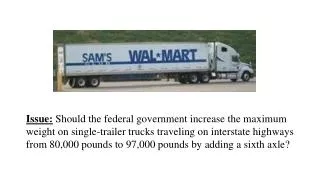
Issue: Should the federal government increase the maximum weight on single-trailer trucks traveling on interstate highways from 80,000 pounds to 97,000 pounds by adding a sixth axle?
Talking Points • Reduce consumption by 2 billion gallons of diesel per year • Reduction of $2.4 billion in pavement restoration costs over the next 20 years on interstate • Allows American producers to reduce the number of shipments needed to deliver a fixed amount of goods - making them more productive and competitive • Since the U.K. raised its weight limit to 97,000 pounds for six-axle vehicles in 2001, fatal truck-related accidents have declined by 35%
Talking Points • Additional cost of repairing bridge damage of $3 billion • Currently trucks pay 80% of damage they cause – by raising the limit from 80,000 to 97,000 pounds they will cover only 50% of the damage • To break even on repair costs 97,000 lb trucks would need to pay an $1.17 per gallon in fuel tax
NLC opposes increases in truck weight limits unless and until such increases are accompanied by simultaneous and sufficient increases in the heavy truck-user tax. • No state laws have been introduced to raise weight limits on state and local roads • A federal issue pitting railroads versus trucks