Understanding and Evaluating Polynomial Functions: Methods and Applications
This chapter delves into polynomial functions, focusing on evaluating polynomials using the Remainder Theorem and direct substitution. It explains key concepts such as zeros and factors of polynomials, highlighting their significance in finding real roots. The chapter also covers graphing polynomial functions, discussing the leading coefficient test, end behavior, and the impact of zero multiplicity. Additionally, it analyzes local maxima and minima in quadratic and cubic functions. Exercises provide practical experience in applying these concepts, encouraging a deeper understanding of polynomial equations and their graphical representations.

Understanding and Evaluating Polynomial Functions: Methods and Applications
E N D
Presentation Transcript
Chapter 2 Review Polynomial Functions
L2.1 – 2.2 Evaluating Polynomials • P(x) = anxn + an-1xn-1 + … + a2x2 + a1x + a0 • Evaluate by • Direct substitution or • Remainder Theorem: When P(x) is divided by (x – a), the remainder is P(a). a.k.a Synthetic Substitution • Zeros and Factors • a is a zero of P(x), if P(a) = 0 [A root refers to the soln to an eqn] • (x – a) is a factor of P(x), if P(x) divided by (x – a) leaves a zero remainder. [Factor Theorem, (x – a) is factor of P(x),iffP(a) = 0] EXERCISES: Give real zeros of each function. • P(x) = (x – 7)2(2x + 1) • f(x) = x3 + 2x2 + x, Also evaluate f(-2) by direct & synthetic substitution • g(x) = 6x2 – 7x – 20 • h(x) = x3 – 5x2 + x – 5 • k(x) = 4x4 – 17x2 + 18
L2.3 Graphing Polynomial Functions • Leading coefficient test: if an > 0 RHS , if an < 0 RHS • If degree of P(x) is even, both ends go in the same direction odd, the ends go in opposite directions • Multiplicity of zeros: (x – a)n is a factor of P(x) • If n is even, graph is tangent to x-axis at a (touches but doesn’t cross) • If n is odd, graph [flattens and ]crosses the x-axis at a. • To graph: identify zeros and create a sign graph to determine intervals where graph is above and below the x-axis. Verify by examining degree and sign of an. EXERCISES: • Sketch graphs. • y = –x2(x + 4)(x – 4) • y = x(x + 3)2 • y = x3(2 – x)
3. 1. 2. (2, 1) (2, -4) 4. L2.3 More Exercises • Write an equation for each graph
x L2.4 Max’s & Min’s of Quadratic & Cubic Functions • Quadratic Functions – max or min occurs at vertex Value is • Cubic Functions – have “local” max’s and min’s. Odd degree functions are unbounded, so have min or max points only within an interval. Use a graphing calculator to approximate max’s or min’s. • EXERCISES: • Two numbers have a difference of 6. Find their minimum possible product. • An open box is to be formed by cutting squares from a 10cm square sheet of metal and then folding up the sides as shown. • Write a function, V(x), to describe the volume of • the resulting box. • Find the domain of V(x). x 10cm
L2.6 Solving Polynomial Equations (finding roots) • Use Quadratic Techniques (Factor, CTS, Quad Formula) • Recast higher degree polynomials to Quadratic Form • Rational Root Theorem – potential rational roots are of the form , where p = factors of a0 and q = factors of an. Test roots using synthetic division and find subsequent roots using depressed polynomial. EXERCISES: Solve. • x3 + 5x2 – 4x – 20 = 0 • 2x4 – x2 – 3 = 0 • 3x4 + 13x3 + 15x2 – 4 = 0
L2.7 General Results for Polynomial Functions • Fundamental Theorem of Algebra: a polynomial of degree n has exactly n roots in the complex number system. • Complex and irrational roots occur in conjugate pairs. • Odd degree polynomials have at least one real root and their graphs are unbounded. • Sum and Product of Roots: • General Polynomial: anxn + an-1xn-1 + … + a2x2 + a1x + a0 = 0 Sum of Roots: Product of Roots: • Quadratics: ax2 + bx + c = 0: Sum = –b/a, Product = c/a EXERCISES: • Find a cubic equation with integral coefficients that has 2 and 4 + i as roots. • A cubic equation has no quadratic term. What are its roots if one of them is . • A quartic (4th degree) equation has no cubic term and no constant term. What are its roots if one of them is .
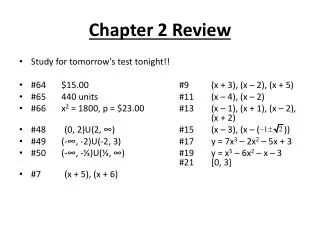
Exercises: Answer Key L2.1–2.2: 1. 7, –1/2; 2. 0, –1,f(–2) = –2; 3. 5/2, –4/3; 4. 5; 5. L2.3a: 1. 2. 3. L2.3b: 1. y = (x – 1)(x – 3)2 2. y = 2(x – 1)(x – 3)2(x – 4) 3. y = ½(x – 2)3 4. y = –(x – 1)3(x – 3) L2.4: 1. The minimum product is –9 and the numbers are –3 and 3. 2. a) The base of the box is a square with length = width = 10 – 2x. The height is x. Volume, V(x) = x(10 – 2x)2 b) x(10 – 2x)2 > 0 so 0 < x < 5 L2.6: 1. , x = -5; 2. ; 3. x = -2, L2.7: 1. x3 – 10x2 + 33x – 34 = 0 2. other roots: , –2 3. other roots: , 0, –6