Mendel, Genes, and Inheritance
490 likes | 869 Vues
Mendel, Genes, and Inheritance . Chapter 12. Gregor Mendel. Austrian Monk with a strong background in plant breeding and mathematics Using pea plants, found indirect but observable evidence of how parents transmit genes to offspring. Mendel’s Work. Bred pea plants


Mendel, Genes, and Inheritance
E N D
Presentation Transcript
Mendel, Genes, and Inheritance Chapter 12
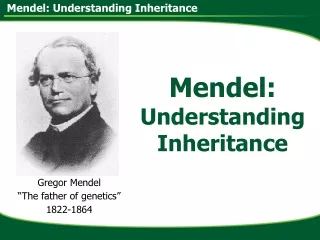
Gregor Mendel • Austrian Monk with a strong background in plant breeding and mathematics • Using pea plants, found indirect but observable evidence of how parents transmit genes to offspring
Mendel’s Work • Bred pea plants • cross-pollinated true breeding parents (P) • raised seed & then observed traits (F1) • filial • allowed offspring to cross-pollinate & observed next generation (F2)
100% purple-flower peas F1 generation (hybrids) 100% self-pollinate 75% purple-flower peas 25% white-flower peas 3:1 F2 generation Mendel’s Experiments true-breeding purple-flower peas true-breeding white-flower peas X P
Genes • Sequences of DNA that contain information about specific traits, by coding for individual proteins • Passed from parents to offspring • Each has a specific location (locus) on a chromosome Alleles • Different versions of the same trait
Genes and inheritence • For each characteristic (gene), a diploid organism inherits 2 sets of alleles • 1 from each parent • Homologous chromosomes • Pairs of chromosomes that contain the same traits (genes) • For each trait there are two alleles (one on each homologous chromosome)
Genetic Terms purple-flower allele & white-flower allele are 2 DNA variations at flower-color locus different versions of gene on homologous chromosomes
Mendel’s Findings: Dominance • Some alleles for a given traits mask others • Dominant allele • Fully expressed in a hybrid • Designated by a capital letter • e.g. P = Purple allele • Recessive allele • no noticeable effect in a hybrid • Designated by a lowercase letter • E.g. p = White allele
Genotype vs. phenotype • Phenotype • Description of an organism’s trait • “visible” characteristic • Genotype • Description of an organism’s genetic makeup; i.e. which alleles are present in the organism • Alleles may be the same or they may be different: • Homozygous = same alleles; PP, pp • Heterozygous = different alleles; Pp
self-pollinate Looking closer at Mendel’s work true-breeding purple-flower peas true-breeding white-flower peas X P PP pp Phenotype: 100% purple-flower peas 100% purple-flower peas F1 generation (hybrids) 100% Pp Pp Pp Pp 75% purple-flower peas 75% purple-flower peas 25% white-flower peas 3:1 3:1 F2 generation ? ? ? ?
PP 25% male / sperm P p Pp 50% 75% P Pp female / eggs pp p 25% 25% Punnett squares % genotype % phenotype Pp x Pp PP Pp Pp pp 1:2:1 3:1
purple PP homozygous dominant purple Pp heterozygous Phenotype vs. genotype • 2 organisms can have the same phenotype but have different genotypes
Dominant phenotypes • It is not possible to determine the genotype of an organism with a dominant phenotype by looking at it. • So how can you figure it out? PP? Pp?
Test cross • Cross-breed the dominant phenotype — unknown genotype — with a homozygous recessive (pp) to determine the identity of the unknown allele x is itPP or Pp? pp
x x Test cross PP pp Pp pp p p p p Pp Pp Pp Pp P P P Pp Pp p pp pp 50%:50%1:1 100%
P P P p p PP Pp pp p Mendel’s laws of heredity (#1) • Law of segregation • when gametes are produced during meiosis, homologous chromosomes separate from each other • each allele for a trait is packaged into a separate gamete
Meiosis 1 Law of Segregation • What meiotic event creates the law of segregation?
Monohybrid cross • Some of Mendel’s experiments followed the inheritance of single characters • flower color • seed color • monohybrid crosses
Dihybrid cross • Other of Mendel’s experiments followed the inheritance of 2 different characters • seed color andseed shape • Dihybrid crosses
yellow, round peas F1 generation (hybrids) 100% self-pollinate 9/16 yellow round peas 3/16 green round peas 3/16 yellow wrinkled peas 1/16 green wrinkled peas 9:3:3:1 F2 generation Dihybrid cross true-breeding yellow, round peas true-breeding green, wrinkled peas P x YYRR yyrr Y = yellow R = round y = green r = wrinkled YyRr
YyRr YyRr YR YR yR Yr yr yr Dihybrid Cross • How are the alleles on different chromosomes handed out? • together or separately?
9/16 yellow round 3/16 green round YR Yr 3/16 yellow wrinkled yR 1/16 green wrinkled yr Dihybrid cross YyRr x YyRr YR Yr yR yr YYRR YYRr YyRR YyRr YYRr YYrr YyRr Yyrr YyRR YyRr yyRR yyRr YyRr Yyrr yyRr yyrr
Mendel’s laws of heredity (#2) Law of independent assortment: • each pair of alleles segregates into gametes independently • 4 classes of gametes are produced in equal amounts • YR, Yr, yR, yr • only true for genes on separate chromosomes YyRr Yr Yr yR yR YR YR yr yr
Meiosis 1 Law of Independent Assortment • What meiotic event creates the law of independent assortment?
The chromosomal basis of Mendel’s laws… Trace the genetic events through meiosis, gamete formation & fertilization to offspring
Review: Mendel’s laws of heredity • Law of segregation • each allele segregates into separate gametes • Law of independent assortment • Observable in dihybrid (or more) cross • 2 or more traits • each pair of alleles for genes on separate chromosomes segregates into gametes independently • Each gamete carries one allele of each trait
Extending Mendelian genetics • Mendel worked with a simple system • peas are genetically simple • most traits are controlled by a single gene • each gene has only 2 alleles, 1 of which is completely dominant to the other • The relationship between genotype & phenotype is rarely that simple
Incomplete dominance • Heterozygotes show an intermediate phenotype • RR = red flowers • rr = white flowers • Rr = pink flowers • make 50% less color
self-pollinate 25% red 50% pink 25% white Incomplete dominance X true-breeding red flowers true-breeding white flowers P 100% pink flowers F1 generation (hybrids) 100% 1:2:1 F2 generation
CRCR 25% 25% male / sperm CR CW CRCW 50% 50% CR CRCW female / eggs CWCW CW 25% 25% Incomplete dominance % genotype % phenotype CRCW x CRCW CRCR CRCW CRCW CWCW 1:2:1 1:2:1
Codominance • BOTH alleles express in heterozygotes • Example: In chickens, feather color trait has two alleles: B= Black feathers W = White feathers • What is phenotype of BB, WW? • What is the phenotype of BW?
Codominance: + WW BB WB
Multiple Alleles • More than two possible alleles for one trait • Example: in ABO blood group, 3 possible alleles: • IA, IB, i • 4 blood types: A, B, O, AB • How?
Pleiotropy • Most genes are pleiotropic • one gene affects more than one phenotypic character • wide-ranging effects due to a single gene: • dwarfism (achondroplasia) • gigantism (acromegaly)
Epistasis • One gene masks another • coat color in mice = 2 genes • pigment (C) or no pigment (c) • more pigment (black=B) or less (brown=b) • cc = albino, no matter B allele • 9:3:3:1 becomes 9:3:4
Epistasis in Labrador retrievers • 2 genes: E & B • pigment (E) or no pigment (e) • how dark pigment will be: black (B) to brown(b)
Polygenic inheritance (continuous variation) • Some phenotypes determined by additive effects of 2 or more genes on a single character • phenotypes on a continuum • human traits • skin color • height • weight • eye color • intelligence • behaviors
Environmental influence • The expression of some genes can be influenced by the environment • for example: coat color in Himalayan rabbits and Siamese cats • an allele produces an enzyme that allows pigment production only at temperatures below 30oC
Acknowledgement • Much of this presentation was modified from the Biology Zone website: http://bio.kimunity.com/