Climate Change
This lecture explores the evolution of Earth's climates, examining the Pleistocene Epoch (2.4 Mya to 10,000 ya), featuring significant glaciations like Nebraskan, Kansan, Illinoian, and Wisconsinan. It delves into the Holocene, starting 10,000 years ago, spotlighting modern analytical methods, including varve counting and oxygen isotope analysis from foraminifera. The course also analyzes climate system feedback mechanisms, recent climate changes, and Earth’s climatic variations due to orbital cycles, solar output changes, volcanic activity, and human impacts on climate.

Climate Change
E N D
Presentation Transcript
Climate Change GEOG 1112- Lecture 19
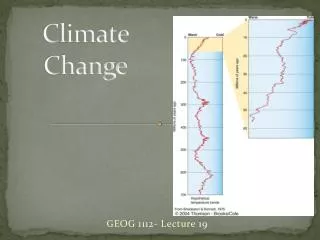
Past Climates • The Pleistocene Epoch • 2.4 Mya – 10,000 ya • Historically, 4 major glaciations: • Nebraskan, Kansan, Illinoian, Wisconsinan • Gumz, Mindel, Riss, Wurm
Past Climates • The Holocene • Since 10,000 ya
Modern Methods of Analysis • Varves: sedimentary couplets in Swedish lakes • A pairing of organic-rich summer sediments and organic-poor winter sediments found in exposed lake beds • Because each pair represents one year of time counting varves is useful as a dating technique for recent Earth history
Modern Methods of Analysis • Foraminifera • Surface-dwelling marine animals who have died and sunk to the sea floor • Produces a history of water temperature fluctuations
Modern Methods of Analysis • Oxygen-Isotope Analysis • A dating method used to reconstruct climate history • Based on the varying evaporation rates of different oxygen isotopes and the changing ratio between the isotopes revealed in foraminifera fossils • Compares ratio between 16-O and 18-O
The Holocene • Since 10,000 ya • The Altithermal • An interval of time about 7,000 years ago when the climate was hotter than it is today
Feedback in Climate Systems • Positive because changes can happen fast • Glaciers reflect sunlight -> less solar heating -> cooling -> more glaciers • Melting exposes more dark material -> lower albedo -> more solar heating -> more warming • Negative because changes stop eventually • Warming -> evaporation -> clouds -> less warming
Causes of Climate Change • Orbital Variations • Changes in Solar Output and Outer Space • Changes in Earth’s Activity
Orbital Variations • Eccentricity Cycle • 100,000 yr. variation in Earth’s orbit around Sun • Most important for last 900,000 yr • Obliquity Cycle • 41,000 yr. variation in Earth’s tilt (22.1 – 24.5 deg) • Most important from 2.4 Mya – 900,000 ya • Precession Cycle • 23,000 yr. variation in aphelion & perhelion • Milutin Milankovitch- 1924 • Predicts full glacial conditions (glacial ice as far south as the Ohio and Missouri Rivers) in about 23,000 years
Changes in Solar Output and Outer Space • 11-year sunspot cycle • Dusty spots in the solar system
Changes in Earth's Activity • Volcanic Activity • Tambora 1815 -> 1816 • ‘Year w/o a summer’ • Krakatoa 1883 • Pinatubo 1991
Changes in Earth's Activity • Atmospheric Gases • Carbon Dioxide and the Greenhouse Effect • Methane and the Greenhouse Effect
Changes in Earth's Activity • Changes in the Ocean • Salinity differences- high evaporation creates salty seas and leads to subsidence • Heinrich Events- salinity at surface is reduced by melting glaciers and deep-water circulation and turnover slow, and N. Hemisphere warms
Changes in Earth's Activity • Changes in Landmasses • Breakup of Pangaea • Connection of Mediterranean to Ocean • Creation of Panama isthmus • Himalaya range restricts flow
Just the facts… Climate Change