Global Aggregation
This document outlines recent updates to Global Aggregation policies as discussed in the ESB CS meeting. A revised draft of Option E has been circulated, which incorporates necessary changes, including provisions for Error Supplier Units. The calculation methodology for Residual Error Volumes aligns with the adopted section 7 algebra. Additionally, explicit definitions for AINDeh and ANINDeh have been established to facilitate clear documentation in the PIR. Various demand adjustment metrics are outlined to support transparency and operational effectiveness across jurisdictions.

Global Aggregation
E N D
Presentation Transcript
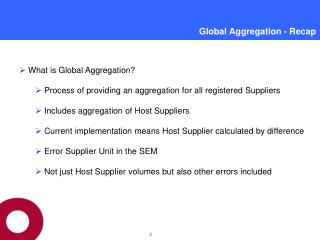
Global Aggregation • Mod 34.09 raised by ESB CS at Mods Meeting 24 (29.09.09) • Draft of Option E version circulated in mid August • Revised version submitted formally on September 1st 2
Global Aggregation • Drafting allows for Error Supplier Unit as required by Licence • Means where Error Supplier Unit exists, option E rules do not impact • Allows for implementations in each jurisdiction to progress separately 3
Global Aggregation • Adopts the section 7 algebra for the calculation of values • Calculation of Residual Error Volume is the same calculation, with the inclusion of the Error Supplier Unit volumes. 4
Global Aggregation • Calculations of AINDeh and ANINDeh explicitly defined in the modification • This is done to facilitate publication of these values in the PIR. 5
Global Aggregation • Changes from draft – • explicit calculation of AIND/ANIND • Renaming of IEP to NIEP • Specification of NDA as distinct variable means Participants can see demand value as separate item from Participant portion of Residual Error Volume . 6
Global Aggregation • For inclusion in PIR • Non-Interval Energy Proportion • Net Demand Adjustment (NDAvh) • Loss-Adjusted Settlement Net Demand (SNDLFvh) • Aggregate Interval Net Demand (AINDeh) • Aggregate Non Interval Net Demand (ANINDeh) 7
Global Aggregation • For inclusion in PIR • Non-Interval Energy Proportion • Net Demand Adjustment (NDAvh) • Loss-Adjusted Settlement Net Demand (SNDLFvh) • Aggregate Interval Net Demand (AINDeh) • Aggregate Non Interval Net Demand (ANINDeh) 8