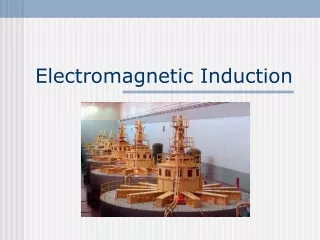
Electromagnetic Induction
This guide explores the principles of electromagnetic induction, highlighting the conditions under which electric current can be induced by changes in magnetic fields. It focuses on Faraday’s Law, which relates the induced electromotive force (emf) to the rate of change of magnetic flux through a coil, and Lenz’s Law, which describes the direction of induced current. The document outlines practical examples, mathematical derivations, and various ways to change magnetic flux to induce current, providing a comprehensive overview of the phenomena that govern electromagnetism.

Electromagnetic Induction
E N D
Presentation Transcript
Electromagnetic Induction Electricity from Magnetism
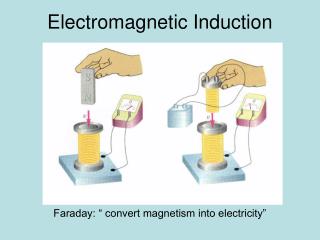
Induced Current • When a conductor is moved in a magnetic field, current can be induced (caused) • Faraday’s Original Experiment
Many Ways to Produce EMF • Many forms of changing magnetic field can produce Emf (current) • Magnet or coil or both can move • Field can turn on or off due to closing or opening a switch
Faraday’s Law (I) • Induced emf is proportional to the rate of change of magnetic fluxFB passing through a loop of area A FB = BAcosq q is angle between B and a line perpendicular to the face of the loop Flux applet Courtesy Dept. of EE Surrey University
Nature of Magnetic Flux • FB = BAcosq is a scalar • Above formula comes from “dot product” of B and A whereas F =Bqvsinq comes from “cross” or vector product B x v • Unit of magnetic flux is tesla-meter2 or weber
Ways of Changing Flux • Move coil into or out of field • Change area of coil • Rotate coil so number of field lines changes • Change field strength • Ways Flux will not change • Rotate coil around field line – doesn’t change number of field lines • Slide coil at constant angle within field
Faraday’s Law (II) • Magnetic flux is also proportional to total number of field lines passing through loop • When q = 00 magnetic flux FB = BA (A is area of loop perpendicular to magnetic field) • When q = 900 magnetic flux is zero; no field lines pass through loop. Mathematically Emf = -N DFB/ Dt • N is number of loops
Almost calculus • DFB/ Dt is time rate of change of flux
Simple example • A square loop of side a enters a region of uniform magnetic field B in time Dt = one second. Write an expression for the voltage induced during that interval • Emf =-N DFB/ Dt = -a2B/1 second =-a2B
Current direction? • How do we know in what direction, clockwise or counterclockwise the induced current will flow? • Energy conservation plays a role • Energy in the current and voltage must come from somewhere • How this works is called Lenz’s Law
Lenz’s Law • Minus sign in Faraday’s Law reminds us that • Induced current produces its own magnetic field • This field interacts with original field to make a force • Work must be done against this force to produce induced current or conservation of energy will be violated An induced emf always gives rise to a current whose magnetic field opposes the original change in flux Applet
How Current Varies • Link (demonstrates Lenz’s Law with bar magnet and loop)
In Other Words • Physical motion that induces current must be resisted by magnetic forces • Something has to do work to induce the current, otherwise energy conservation is violated
What is Direction of Current? loop Current clockwise Field in this region toward us
Changing Area – What is the direction of induced current? • Field away from us xxx • Field toward us . . . Answer to 1. CW. Induced field away to restore existing field Answer to 2. CCW. Field toward us to restore existing field Loop area shrinks
What if Loop Area Increases? • Answers reverse • 1 CCW • 2 CW
Another Example of Lenz’s Law • When field is increasing, induced field opposes it • When field is decreasing, induced field acts in the same direction Diagram courtesy Hyperphysics web site
Example: Square coil side 5.0 cm with 100 loops removed from 0.60T uniform field in 0.10 sec. Find emf induced. • Find how flux FB = BA changes during Dt = 0.10 sec. • A = • InitialFB • FinalFB =zero • Change in flux is • Emf = -(100)(-1.5 x 10⁻³ Wb)/(0.10 s) = 2.5 x 10⁻³ m2 1.5 x 10⁻³ Wb -1.5 x 10⁻³ Wb 1.5 volts
Example, continued • If resistance of coil is 100 ohms what are current, energy dissipated, and average force required? • I = emf/R = 1.5v/100 ohms = • E = Pt = I2Rt= • F = work required to pull coil out/distance = energy dissipated in coil/distance = W/d = 15mA 2.25 x 10⁻³ J 0.050 N Use d = 0.05 m since no flux change until one edge leaves field
EMF in a Moving Conductor Courtesy P Rubin, university of Richmond
Moving Rod Changes Area of Loop • Let rod move to right at speed v • Travels distance Dx = v Dt • Area increases by DA = LDx=L v Dt • By Faraday’s law • Emf = DFB/ Dt = BDA/Dt = BLvDt/Dt = BLv • B, L and v must be mutually perpendicular
Alternate Derivation of emf = BLv • Force on electron in rod moving perpendicular to magnetic field strength B with speed v is F=qvB acting downward • Produces emf with top of rod + • CCW conventional current as rod slides to right • Work to move a charge through rod against potential difference is • W = Fd = qvBL. Emf is work per unit charge BLv
Blv Example: Voltage across an airplane wing • Airplane with 70 m wing travels 1000 km/hr through earth’s field of 5 x 10⁻⁵ T. Find potential difference across wing. Is this dangerous? • Emf = Blv = • Could such a potential difference be used to reduce the aircraft’s need for fuel? (5.0 x 10⁻⁵ T) (70m) (280 m/s) = 1.0volt
The Generator Generators and alternators work by rotating a coil in a magnetic field. They produce alternating current.