Understanding IP Address Classes and Subnet Masking
Learn about IP address classes (A, B, C, D, E) and subnet masking for efficient network management. Explore private addresses and NAT.

Understanding IP Address Classes and Subnet Masking
E N D
Presentation Transcript
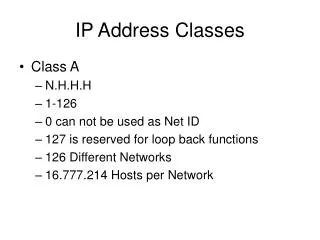
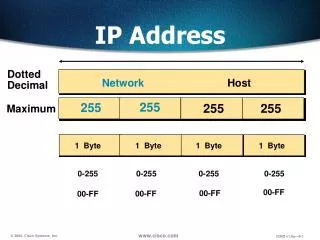
IP Address Classes • Class A • N.H.H.H • 1-126 • 0 can not be used as Net ID • 127 is reserved for loop back functions • 126 Different Networks • 16.777.214 Hosts per Network
IP Address Classes • Class B • N.N.H.H • 128-191 • The first IP Address is the NET ID • The last IP Address is the Broadcast Address • 16.384 Different Networks • 65543 Hosts per Network
IP Address Classes • Class C • N.N.N.H • 192-223 • The first IP Address is the NET ID • The last IP Address is the Broadcast Address • 2.097.152 Different Networks • 254 Hosts per Network
IP Address Classes CLASS D – Used for multicast broadcasts CLASS E – Experimental addresses not available to the public
SUBNET MASKING • Smaller broadcast domains • More manageable networks • Save IP Addresses Default Subnet Mask • CLASS A - 255.0.0.0 • CLASS B - 255.255.0.0 • CLASS C - 255.255.255.0
SUBNET MASKING 4000 Hosts NET ID – 190.100.0.0 CLASS B 212=4096 D.S.M - 255.255.0.0 255.255.11110000.00000000 255.255.240.0 is the Subnet 256-240 = 16
SUBNET MASKING • Subnet Mask is 255.255.240.0 • 190.100.16.1 - 190.100.31.254 • 190.100.32.1 - 190.100.47.254 • 190.100.48.1 - ………………. • Net ID • 190.100.16.0 • 190.100.32.0 • Broadcast • 190.100.31.255 • 190.100.47.255
500 Hosts NET ID – 190.100.0.0
Private Addresses • There are certain address in each class that are not assigned. These are called private addresses. • Private addresses are not routed on the internet. • Network Address Translation (NAT) can be used to connect these Private Networks to the Internet