AGENT EXOPLANET
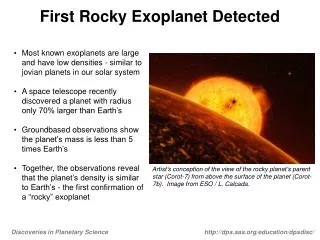
This project explores exoplanet detection methods, primarily focusing on the transit and radial velocity techniques. The transit method requires precise alignment between a planet's orbit and our viewpoint, allowing us to measure orbital parameters like semi-major axis and transit duration. We also delve into radial velocity, which observes the gravitational influence of a planet on its star, helping us determine the planet's minimum mass. This discussion highlights the advantages and challenges of both methods and showcases confirmed exoplanets, including Gliese 581-d, which shows potential for habitability.


AGENT EXOPLANET
E N D
Presentation Transcript
AGENT EXOPLANET Sarah, Ellie, Adan and Sruthy
The main disadvantage of the transit method is that for us to detect a planet, the orbit must be precisely aligned with our point of view.
TrES-3b Jupiter compared to TrES-3b
Theory • Radius, mass of star, as well as planet’s period, estimated through observation • Then you can calculate: • semi-major axis • orbital speed • radius • transit duration • impact parameter • Inclination • Calculations based on Newton & Kepler’s Laws.
Qatar-1b .
WASP-2bSP-2b Jupiter compared to WASP-2b
Detecting Exoplanets Using Radial Velocity or the Doppler Method
What is radial velocity? Velocity along the line of sight toward or away from the observer. This diagram shows how an orbiting planet will change the position of the star it orbits due to its gravitational tug.
What is spectroscopic radial velocity and how can it be used to determine a planet’s radial velocity? S.R.V is the radial component of the velocity of the source at emission and the observer at observation, as determined by spectroscopy.
Advantages and Disadvantages of using the radial velocity method. Advantage: • The planet's eccentricity can be measured directly. Disadvantage: • Can only estimate a planet’s minimum mass.
Easier to detect planets orbiting low mass stars because.... • More affected by the planets’ gravitational tug. • Generally, the planets rotate more slowly when orbiting a low mass star.
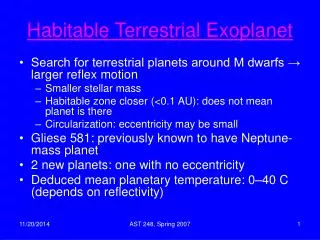
R.V. Method is the most productive method used... 456 Exoplanets – 31 confirmed and 323 candidates. Of the 31 confirmed Exoplanets – 1 Exoplanet has been identified as having the potential for habitability – Gliese 581-d