Download
1 / 19
190 likes | 322 Vues
This paper proposes a novel security architecture aimed at protecting commodity operating system kernels from vulnerabilities associated with device drivers. Device drivers operate with kernel privileges, allowing unfettered access to critical kernel data structures, which presents significant security risks. Our architecture enables device drivers to execute in user mode without degrading common-case performance. The design focuses on ensuring kernel data integrity, compatibility with existing systems, and the efficient monitoring of driver interactions. Performance evaluations were conducted on various drivers to assess the effectiveness of the proposed solution.

E N D
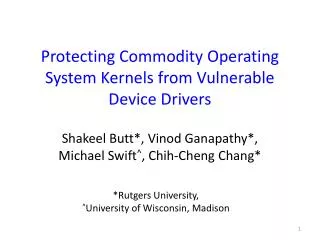
Protecting Commodity Operating System Kernels from Vulnerable Device Drivers Shakeel Butt @ Rutgers University VinodGanapathy @ Rutgers University Michael M. Swift @ University of Wisconsin-Madison Chih-Cheng Chang @ Rutgers University ACSAC 2009
Outline • Introduction • Background and scope • Design • Implementation • Evaluation • Related Work • Summary
Introduction • Device drivers execute with kernel privilege in most commodity operating systems and have unrestricted access to kernel data structure. • Propose a security architecture that offers commodity operating systems the benefits of executing device drivers in user mode without affecting common-case performance
Background and Scope • Threats at the kernel/driver interface • Kernel data structures are routinely updated by device drivers, and the kernel impose no restrictions on the memory regions accessible to drivers or devices. • Threats at the driver/device interface • A compromised driver can maliciously modify the state of the device
Design • Goals • Kernel data structure integrity • Good common-case performance • Compatibility
Design • Architecture
Design • Microdriver • Consist of k-driver & u-driver • Microdriver runtime • Communication • Object tracking • RPC monitor • Monitor data transfer • Monitor control transfer
Implementation • Background on Microdrivers
Implementation • Microdriver split tool - DriverSlicer • Splitter • Code generator • Invariant inference tool – Daikon • Front end • Inference engine
Implementation • Monitoring kernel data structure updates • Training phace • Inferring data structure integrity constraints • Constancy of scalars and pointers • Relationships between variables • Ranges/sets of values • Linked list invariants
Implementation • Enforcement phase • Enforcing data structure integrity constraints • Invariant table • Vault table
Inplementation • Monitoring control transfers • Extracting control transfer policies • Static analysis • Enforcing control transfer policies • Upcall • Downcall
Evaluation • Conduct on four drivers • RealTek RTL-8139 (8139too) • RealTek RTL-8139C+ (8139cp) • Ensoniq sound card (ens1371) • USB interface (uhci-hcd)
Evaluation • Privilege separation
Evaluation • Ability to prevent attacks • Control hijacking via injected downcalls • Control hijacking via modified function pointers • Non-control data attacks
Evaluation • False positives and negatives
Evaluation • Performance • TCP receive and send buffer sizes of 87KB and 16KB, respectively. • Copy a 140MB file into a USB disk • Play a 256-Kbps MP3
Related Work • Hardware-based isolation techniques • Virtual machine-based techniques • Language-based mechanisms • Microkernels • User-mode driver frameworks
Summary • Better isolate kernel data from device drivers without sacrificing performance. • Compatible with commodity operating system.