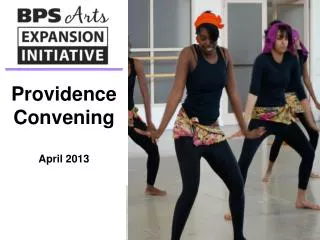
Providence Convening April 2013
110 likes | 239 Vues
In April 2013, Boston initiated a multi-year strategy to enhance access to high-quality arts education for all K-8 students. With a goal to ensure that every student receives weekly, year-long arts instruction, the program has seen nearly a 20% increase in access and more than doubled high school opportunities. Funded through local and Wallace support, the initiative emphasizes building capacity and leveraging partnerships. Key learnings stress the importance of data-driven decision-making, broad stakeholder engagement, and developing sustainable pathways for arts education in schools.


Providence Convening April 2013
E N D
Presentation Transcript
Providence Convening April 2013
Vision & Principles Access ~ Equity ~ Quality “Arts are crucial to a rigorous and high-quality education – and access to the arts in schools is an issue of equity for all of Boston’s children.” – Dr. Carol R. Johnson, Superintendent
Implementation Plan • Phase I – SY2008-2011 • Phase II – SY2012-2015 Key Expansion Goal: 100% of students in K-8 receive weekly, year-long instruction Access+ Equity Planning Investing Quality Capacity building Sustaining
Strategy and Approach A multi-year, three-part strategy: • Expand direct in-school arts education • Build capacity of BPS schools and central office • Strengthen partnership coordination to leverage cultural resources
Progress to Date: Access • Nearly 20% increase in K-8 access to weekly, year-long instruction • More than doubled high school arts opportunities • 14,000 additional students now accessing arts learning opportunities
Arts Expansion Funding • Local Arts Expansion Fund supports direct arts instruction • $4.5M of $5.5M raised to date • Wallace funds support the adult work and capacity-building to build a sustainable system • Now $10M enterprise over 6+ years • Complemented by increased public funds from schools & district (+$2M annually) for more arts teachers
Current Work: Phase II • Central Office and Leadership • Teachers and Curriculum • Assessment and Data • Sustainability – Communications & Outreach
Stakeholder Involvement Over 60 Arts Specialists, Principals and Headmasters, Nonprofit Partners and Researchers
Key Learnings • Use data – it is a powerful tool • Neutralizes old disagreements • Drives goal setting, measurement and momentum • Engage stakeholders broadly and consistently • Construct a thoughtful public/private partnership from the beginning, that builds on the context of a city • Build school district capacity as key lever to increased access and quality of arts instruction
Current Challenges • Dosage, frequency and pathways – What dosage and frequency has impact and is attainable during the school day? How do we ensure pathways within and among schools? • Sustainability: for district and for arts partners • Rewarding new ways of working for schools without strong arts, supporting schools prioritizing the arts, keeping them all engaged for the long term • Making the case and embedding the effort in schools
“Expanding the arts in schools brings new energy to classrooms, increases engagement by students, and improves school choices for families. The arts enrich our young people, our schools, and our neighborhoods.” - Mayor Thomas M. Menino