Understanding Relational Calculus for Efficient Queries
220 likes | 308 Vues
Learn about relational calculus, query forms, quantifiers, and examples like simple queries, joins, and universal quantification. Discover the expressive power and limitations of relational calculus versus algebra.


Understanding Relational Calculus for Efficient Queries
E N D
Presentation Transcript
Relational Calculus
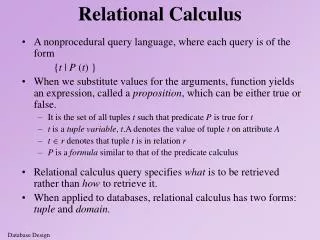
Relational Calculus • Query has the form: {T | p(T)} • p(T)is a formula containing T • Answer = tuples T for which p(T)= true.
Formulae • Atomic formulae: T Relation T.aopT.b T.aopconstant … op is one of • Aformula can be: • an atomic formula
Free and Bound Variables • Quantifiers: and • Use of or bindsX. • A variable that is not bound is free. • Recall our definition of a query: • {T | p(T)} • Important restriction: • Tmust be the only free variable in p(T). • all other variables must be bound using a quantifier.
Simple Queries {S |S Sailors S.rating > 7} • Find all sailors with rating above 7 • Find names and ages of sailors with rating above 7. • Note: S is a variable of 2 fields (i.e. S is a projection of Sailors) {S | S1 Sailors(S1.rating > 7 S.sname = S1.sname S.age = S1.age)}
Joins Find sailors rated > 7 who’ve reserved boat #103 { S | SSailors S.rating > 7 R(RReserves R.sid = S.sid R.bid = 103) }
Joins (continued) Find sailors rated > 7 who’ve reserved a red boat • This may look cumbersome, but it’s not so different from SQL! { S | SSailors S.rating > 7 R(RReserves R.sid = S.sid B(BBoats B.bid = R.bid B.color = ‘red’)) }
Universal Quantification Find sailors who’ve reserved all boats { S | SSailors BBoats (RReserves (S.sid = R.sid B.bid = R.bid)) }
A trickier example… Find sailors who’ve reserved all Red boats { S | SSailors B Boats ( B.color = ‘red’ R(RReserves S.sid = R.sid B.bid = R.bid)) } Alternatively… { S | SSailors B Boats ( B.color ‘red’ R(RReserves S.sid = R.sid B.bid = R.bid)) }
a b is the same as a b b T F T F T a T T F
A Remark: Unsafe Queries • syntactically correct calculus queries that have an infinite number of answers! Unsafe queries. • e.g., • Solution???? Don’t do that!
Your turn … • Schema: Movie(title, year, studioName) ActsIn(movieTitle, starName) Star(name, gender, birthdate, salary) • Queries to write in Relational Calculus: • Find all movies by Paramount studio • … movies whose stars are all women • … movies starring Kevin Bacon • Find stars who have been in a film w/Kevin Bacon • Stars within six degrees of Kevin Bacon* • Stars connected to K. Bacon via any number of films** * Try two degrees for starters ** Good luck with this one!
Answers … • Find all movies by Paramount studio {M | MMovie M.studioName = ‘Paramount’}
Answers … • Movies whose stars are all women {M | MMovie AActsIn((A.movieTitle = M.title) SStar(S.name = A.starName S.gender = ‘F’))}
Answers … • Movies starring Kevin Bacon {M | MMovie AActsIn(A.movieTitle = M.title A.starName = ‘Bacon’))}
S: A: movie name movie star … star ‘Bacon’ A2: Answers … {S | SStar AActsIn(A.starName = S.name A2ActsIn(A2.movieTitle = A.movieTitle A2.starName = ‘Bacon’))} • Stars who have been in a film w/Kevin Bacon
two Answers … • Stars within six degrees of Kevin Bacon {S | SStar AActsIn(A.starName = S.name A2ActsIn(A2.movieTitle = A.movieTitle A3ActsIn(A3.starName = A2.starName A4ActsIn(A4.movieTitle = A3.movieTitle A4.starName = ‘Bacon’))}
A: A2: movie movie name movie movie star star star … star ‘Bacon’ Two degrees: S: A3: A4:
Answers … • Stars connected to K. Bacon via any number of films • Sorry … that was a trick question • Not expressible in relational calculus!! • What about in relational algebra? • We will be able to answer this question shortly …
Expressive Power • Expressive Power (Theorem due to Codd): • Every query that can be expressed in relational algebra can be expressed as a safe query in relational calculus; the converse is also true. • Relational Completeness: Query language (e.g., SQL) can express every query that is expressible in relational algebra/calculus. (actually, SQL is more powerful, as we will see…)
Question: • Can we express query #6 in relational algebra? • A: If we could, then by Codd’s theorem we could also express it in relational calculus. However, we know the latter is not possible, so the answer isno.
Summary • Formal query languages — simple and powerful. • Relational algebra is operational • used as internal representation for query evaluation plans. • Relational calculus is “declarative” • query = “what you want”, not “how to compute it” • Same expressive power --> relational completeness. • Several ways of expressing a given query • a queryoptimizer should choose the most efficient version.