The History and Functionality of the Slide Rule: From Ancient Calculations to Space Exploration
180 likes | 329 Vues
The slide rule, invented by William Oughtred in 1630, revolutionized calculations for scientists and engineers until the rise of digital calculators in the late 20th century. This tool, which utilized logarithmic principles, was essential for precision calculations in numerous fields. Notably, the Apollo 11 astronauts brought a Pickett 600-T slide rule on their lunar mission, marking a significant element of human innovation. Explore its historical significance, mathematical applications, and its legacy in the realm of computation.


The History and Functionality of the Slide Rule: From Ancient Calculations to Space Exploration
E N D
Presentation Transcript
The Chinese Abacus The School Abacus The Abacus
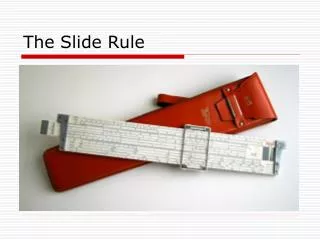
Then came:“The Slide Rule” Prior to 1980, Webster's Dictionary defined the word “COMPUTER” as a person who computes, typically with a slide rule!
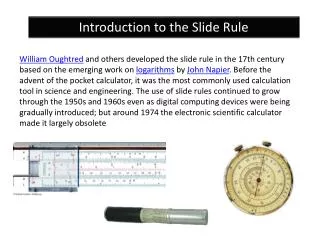
“History of the Slide Rule” • 1630 - Invention of the slide rule by William Oughtred • 1890 - William Cox of the U.S. patented the slide rule. • 1950 thru 1970 - The precision of the slide rule causes it to be used extensively by scientists and engineers. • 1976 - The final slide rule made by K&E donated to the Smithsonian Institute, Washington, DC, USA.
During the 1960’s, the slide rule was used by every scientist and engineer. Knowing the principles of a slide rule help understand the nature of a logarithm.
What is a logarithm? A logarithm is the exponent or power to which a stated number, called the base, is raised to yield a specific number. The logarithm of 100 to the base 10 is 2 This is written: log 10 100 = 2 So the logarithm is _____ ?
Apollo 11 - NASA's Lunar Lander space vehicle, with the crew Neil Armstrong, Buzz Aldrin and Michael Collins carried the slide rule, for the first time in history, into space and onto the Moon! July, 1969.
The Pickett 600-T (white) was taken by the Apollo 11 NASA astronauts to moon!
The First Pocket Calculator The HP-35 “Slide Rule Calculator” First introduced in mid-1970's Sold for $295.00 or $3000 in today's money!
Multiplication (uses C and D scales)Example: calculate 2.3 × 3.4
Simple Division (use C & D scales) Calculate 4.5 / 7.81. Move the cursor to 4.5 on the D scale. 2. Slide 7.8 on the C scale to the cursor.
Calculate the following: 1.9 x 5 = ?
Calculate the following: 3.1 x 5 = ?