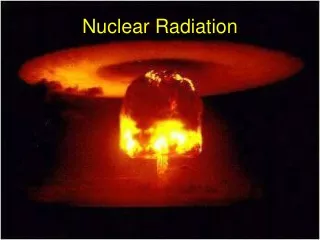
Nuclear Radiation
This comprehensive guide explores the basics of nuclear radiation, focusing on unstable isotopes, their radioactive properties, and types of radiation such as alpha, beta, and gamma. It explains crucial concepts like half-life, transmutation, and the processes of fission and fusion, highlighting their significance in nuclear power generation and medical applications. The guide also addresses the implications of nuclear waste management and the release of energy in nuclear reactions, making it an essential resource for understanding atomic interactions and their practical uses.

Nuclear Radiation
E N D
Presentation Transcript
Nuclear Radiation (c) Douglas E. Raynie, South Dakota State University, 2002
Natural Radioactivity: • Isotopes of some elements may have unstable nuclei. • They will spontaneously (naturally) emit energy to become more stable. • They are RADIOACTIVE. • Elements greater than atomic number 84 are all radioactive. (c) Douglas E. Raynie, South Dakota State University, 2002
14 6 C Writing Isotopes Atomic Mass (sum of protons and neutrons) Element = carbon Atomic Mass = 14 # of protons = 6 # of neutrons = 8 Atomic Number (# of protons)
141 58 Ce Your Turn Element = Atomic Mass = # of protons = # of neutrons =
Types of Radiation • Alpha Particles • Beta Particles • Gamma rays
ALPHA (a) PARTICLE • identical to heliumnucleus. • has 2 protons and 2 neutrons
BETA (b) PARTICLE • is a high-energy • electron, so it has a negative charge and • mass number of 0.
Gamma Emitters: • Atomic number and mass number do not change since gamma radiation consists of energy, not mass.
Radioactive Isotopes: • TRANSMUTATION is the process of changing one element into another. • A stable atom can be bombarded with fast-moving a particles, protons, or neutrons. • A radioactive isotope is called a RADIOISOTOPE (c) Douglas E. Raynie, South Dakota State University, 2002
Half-Life: • The HALF-LIFE of a radioisotope is the amount of time it takes for half of the sample to decay. • A DECAY CURVE is a graph of the decay of a radioisotope (amount vs. time). (c) Douglas E. Raynie, South Dakota State University, 2002
Half-life: • By knowing the half-life, we can do lots of • important things, like: • Carbon dating of fossils • Medical diagnosis • Predict the fate of nuclear waste (c) Douglas E. Raynie, South Dakota State University, 2002
Fission • The splitting a big atom into two smaller atoms by bombarding with neutrons. (c) Douglas E. Raynie, South Dakota State University, 2002
Chain Reaction: • The fission process can continue until all of the available “big atoms” are gone. • This is a CHAIN REACTION. (c) Douglas E. Raynie, South Dakota State University, 2002
Why is energy released? • Just like a chemical equation, a nuclear equation shows reactants and products.
…Some mass is lost… • It just so happens, the mass of the products is slightly less than the mass of the reactants! Before After Slightly less mass
Einstein tells us …E = mc2 Energy = Mass x (Speed of Light)2 Energy = Mass x (300,000 km per second)2 • Therefore… • One kg of mass converted to energy, has the same explosive power as 8 million tons of TNT
Nuclear Power: • This is a fission reaction. • How they work… that’s for another time... (c) Douglas E. Raynie, South Dakota State University, 2002
Nuclear Power: Fission is the process that creates steam in our current nuclear power plants Nuclear waste: The products of fission reactions are unstable, and highly radioactive. Because of its long half-life, some nuclear waste must be kept from entering the environment for 100,000 years or more. (c) Douglas E. Raynie, South Dakota State University, 2002
Fusion: • FUSION is the combining of two small atoms into one bigger atom with the release of energy. • More energy is released than fission. (c) Douglas E. Raynie, South Dakota State University, 2002