Simple Harmonic Motion
Simple Harmonic Motion (SHM) describes the back and forth movement of systems such as springs and pendulums. In SHM, displacement refers to how far an object is pulled from its equilibrium position. Upon release, springs exert a restoring force proportional to displacement, leading to oscillation. Factors like amplitude, period, and frequency come into play, with the period depending on the length of the string or spring constant. Mass influences the period, while restoring force is key to maintaining motion in these systems.

Simple Harmonic Motion
E N D
Presentation Transcript
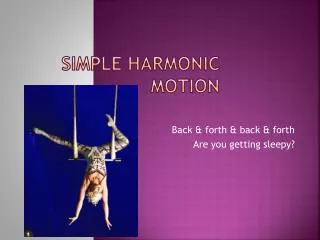
Simple Harmonic Motion Back & forth & back & forth Are you getting sleepy?
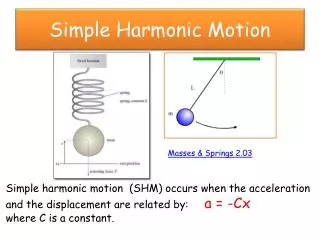
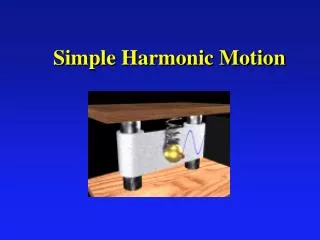
Harmonic motion – back & forth over the same path • X = displacement – distance pulled/stretched from equilibrium • When released – spring exerts a force on the mass towards equilibrium • Vmax @ equilibrium • p causes it to overshoot • @ max stretch/compression – • V = 0, acceleration & force @ max
Remember Hooke’s Law? • Felastic = -kx Pendulums
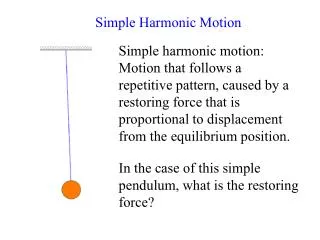
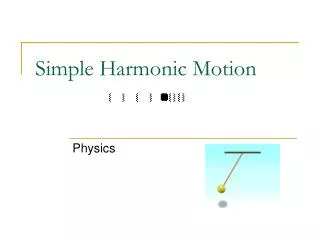
Pendulum • Disregard mass of string, air resistance, friction • If restoring F proportional to displacement = harmonic motion • Small angles of displacement equal simple harmonic motion • Free body diagrams (miss them?!) to Resolve into x & y components
Amplitude = max displacement from equilibrium (rad or m) • Angle of pendulum, spring stretched/compressed • Period = one full cycle of motion (T) in seconds • Time per cycle • Depends on length of the string & free fall acceleration • Frequency = # of cycles through a unit of time (f) in Hertz or
L = length of the string • g = acceleration due to gravity • String length varies = different arc lengths to travel through = different T • Mass varies = no effect on T (more force to restore equilibrium but more force to start) • Amplitude = affected by g
For springs: • m = mass • K = spring constant • Mass affects period • < mass = < T